AC Electrical Repair: The Shocking 5000 Rule
Why Air Conditioning Systems Fail Electrically
AC electrical repair is often needed when your cooling system won't start, trips circuit breakers, or makes unusual sounds. These issues typically stem from failed capacitors, worn contactors, or damaged wiring. Due to the complexity and safety risks of high-voltage components, most electrical AC failures require professional diagnosis and repair.
Quick Answer: When You Need AC Electrical Repair
- Unit won't turn on at all → Check breaker first, then call a professional
- Breaker trips repeatedly → Likely a short circuit or failing component
- Humming but not starting → Usually a bad capacitor (most common repair)
- Burning smell or smoke → Shut off power immediately and call an electrician
- Clicking or chattering sounds → Often a failing contactor relay
- System runs but cools poorly → May be a thermostat or control board issue
Air conditioning systems rely on a chain of electrical components, and when one fails, your comfort disappears fast. The problem is that
electrical failures are dangerous. Unlike changing an air filter, AC electrical repair involves high-voltage parts that can cause serious injury or property damage if handled incorrectly. A failed capacitor, for example, can hold a powerful electrical charge even when the power is off.
Recognizing the warning signs early can save you from a complete system failure or a dangerous electrical hazard.
As
Ed Sartell, President of Sartell Electrical Services since 1985, I've spent nearly four decades diagnosing and repairing electrical systems throughout Massachusetts, including countless AC electrical repair projects. I've seen how the right diagnosis and proper repair make all the difference in getting your cooling system back online safely.
Identifying the Shocking Truth: Signs Your AC Has an Electrical Problem
When your AC quits on a hot day,
electrical problems are often the real troublemaker. Recognizing the warning signs early can prevent small issues from turning into expensive emergencies.

So how do you know if your AC has an electrical problem? Look for these signs:
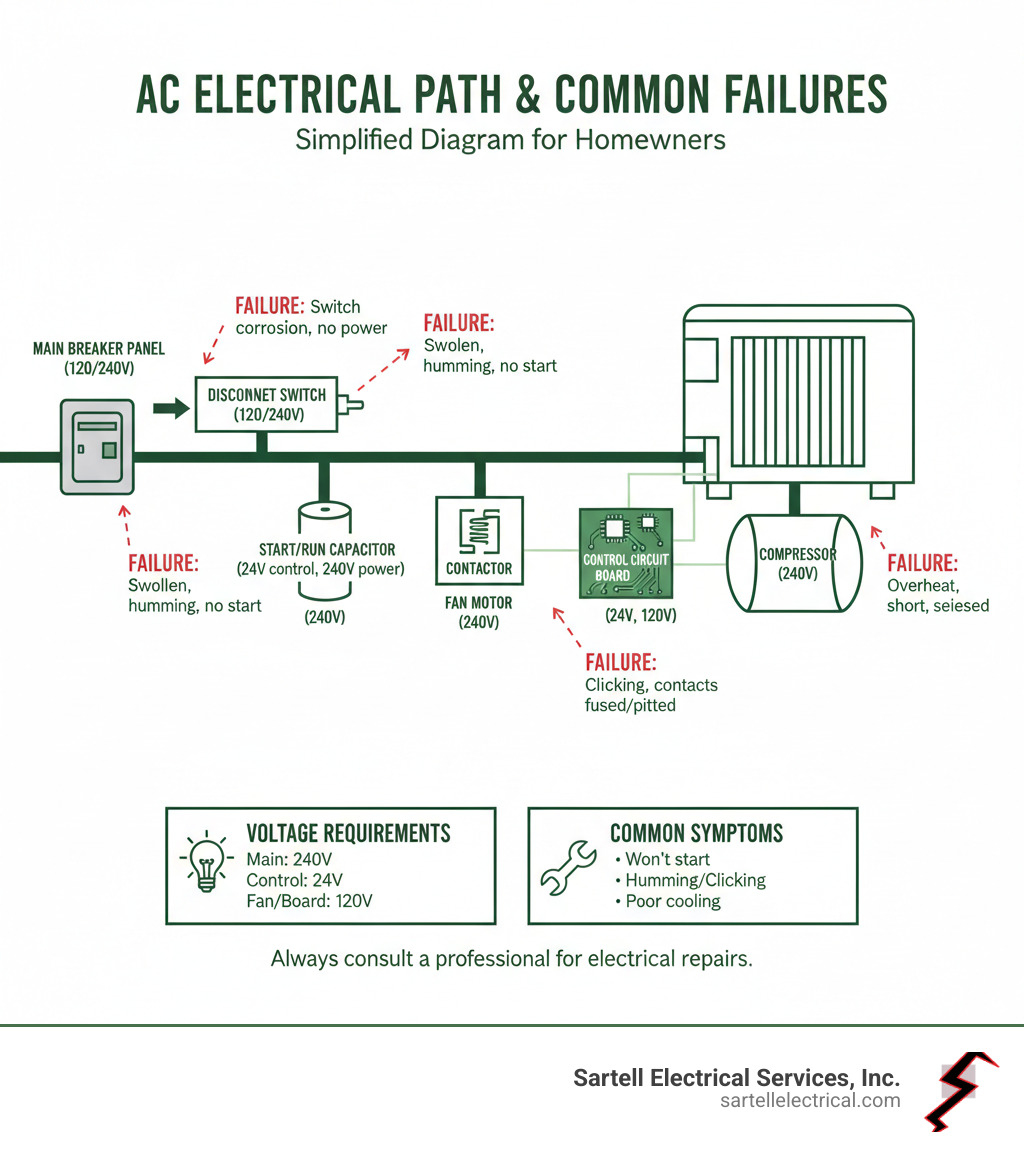
- A circuit breaker that keeps tripping: This is a clear warning of an electrical overload, a short circuit, or a component pulling too much power.
- Unexpected shutdowns: If your unit turns off before reaching the set temperature, it could be a faulty thermostat, loose wiring, or a failing control board.
- A persistent humming or buzzing sound: This often means a capacitor or motor is failing, especially if the AC struggles to start.
- Any burning smell: Shut off the unit immediately. This indicates overheating electrical components and is a serious safety hazard.
- Flickering lights: While some power draw at startup is normal, excessive flickering suggests your electrical system is struggling with the load.
- A sudden spike in energy costs: Electrical problems can force the system to strain, consuming more power. For help diagnosing these issues, check out our guide on electrical troubleshooting costs.
- Inconsistent cooling: If the unit runs but doesn't cool effectively, it could be the thermostat, a fan motor issue, or a failing capacitor.
Your First Checks: Simple Troubleshooting Steps
Before calling for professional
ac electrical repair, try these safe checks:
- Thermostat Settings: Ensure it's set to "Cool" and the temperature is below the current room temperature.
- Thermostat Batteries: If the display is dim or blank, try replacing the batteries.
- Air Filter: A clogged filter restricts airflow and strains the system. Replace it if it's dirty.
- Circuit Breaker: Find the AC breaker. If it's tripped, switch it fully "Off," then back "On." If it trips again, stop and call a professional. Do not keep resetting it.
- Outdoor Disconnect Switch: This small box near your outdoor unit should have its switch in the "On" position.
When Symptoms Point to Electrical Failure
When you see these signs, it's time to call a professional for
ac electrical repair:
- Your AC won't turn on at all, even after checking the breaker and thermostat.
- The breaker trips immediately or frequently.
- Your unit hums but the fan doesn't spin or the compressor won't start (a classic sign of a failed capacitor).
- You notice visible signs of damage like burn marks, melted wires, or a bulging capacitor.
- You smell a burning odor from the unit or vents.
Common Culprits: A Deep Dive into AC Electrical Components and Failures
When your air conditioner fails, the problem usually traces back to a handful of key electrical components. Understanding these parts helps you know when to call for professional
ac electrical repair.
The AC Capacitor: The Most Common Failure
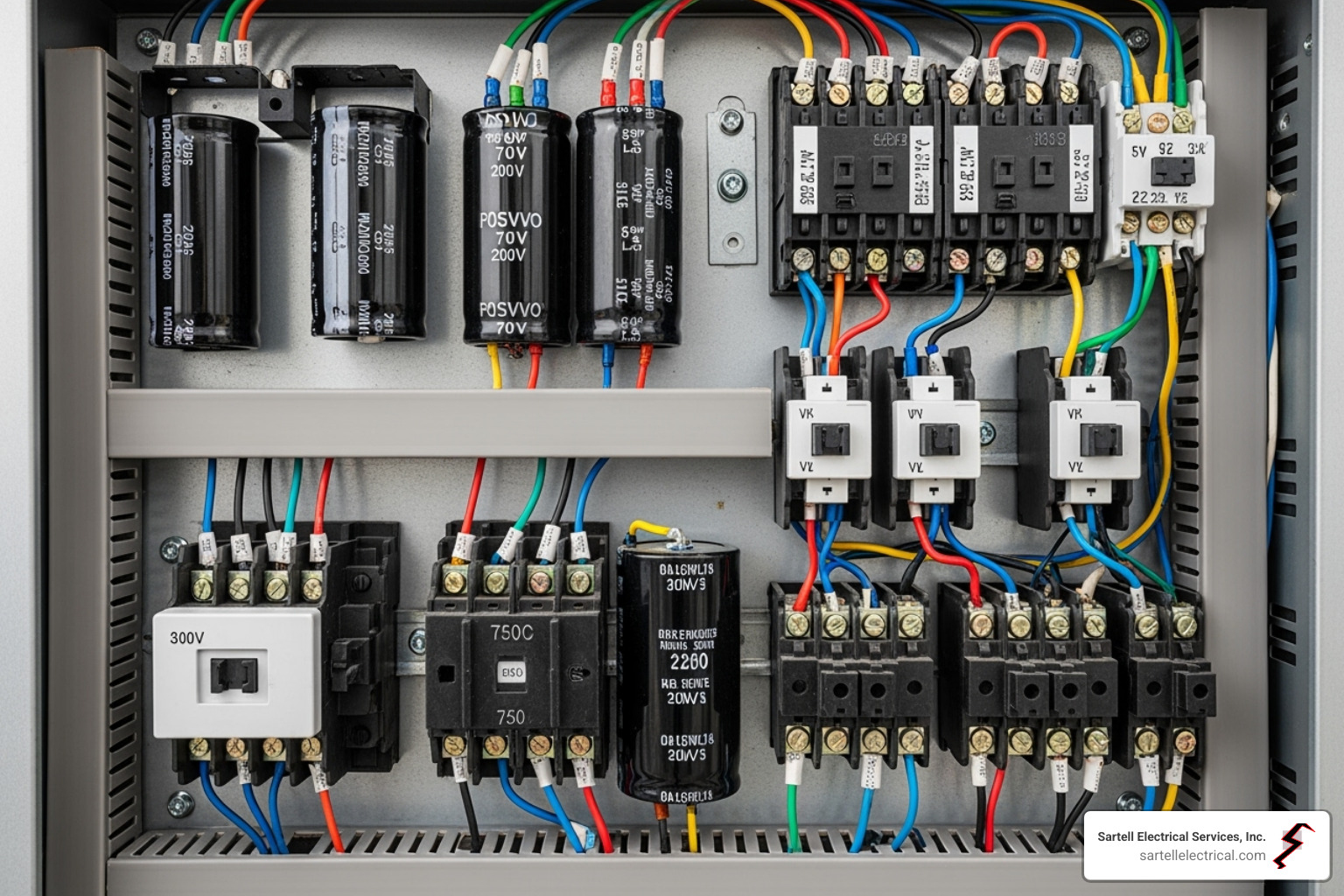
The capacitor is the most common electrical failure we repair. It acts like a small battery, giving your AC's fan and compressor motors the jolt they need to start.
Signs of a failed capacitor:
- A humming noise from the outdoor unit as the motor tries to start.
- The fan won't spin or spins very slowly.
- The top of the capacitor is bulging or leaking fluid.
Warning: Replacing a capacitor is
not a DIY job. Capacitors store a powerful electrical charge even when the power is off, and can deliver a fatal shock. Safe replacement requires special tools and training to properly discharge the component.
The contactor is a heavy-duty switch that controls the flow of high-voltage power to your compressor and fan. When your thermostat calls for cooling, it sends a low-voltage signal to the contactor, which closes a circuit to send 240 volts to the motors.
A failing contactor often makes a
chattering or rapid clicking sound. The internal contacts can become pitted or burnt over time, preventing the unit from starting. A professional can replace a contactor quickly, but it still involves working with high voltage.
Understanding AC Circuit Board Failure
The control board is the "brain" of your AC, orchestrating its entire operation. When it fails, the unit may become unresponsive, start and stop randomly, or fail to run altogether.
Power surges are the number one cause of circuit board failure, which is why we recommend surge protection for AC systems. Age and heat also degrade boards over time. A failed board is almost always replaced rather than repaired. For complex electrical systems, Sartell Electrical Services brings decades of diagnostic experience. Learn more about our
industrial electrical solutions.
Damaged Wiring and Voltage Issues
Sometimes the problem is the wiring itself. Rodents can chew through insulation, and vibrations can loosen connections over time, creating a fire hazard. Look for
burn marks, melted insulation, or the smell of burning plastic—if you see these, shut off power immediately and call for help. Damaged wiring is an emergency that can threaten your home. We provide
ground fault repair and other protective services for such safety issues.
Voltage problems also cause damage. Too little voltage forces motors to work harder (a "hard start"), leading to premature failure. If your lights dim significantly when the AC kicks on, it's a red flag for voltage issues that need professional evaluation.
DIY vs. Pro: Your Guide to Safe and Effective AC Electrical Repair
While it's tempting to fix a broken AC yourself,
AC electrical repair has a clear boundary between safe DIY tasks and jobs for professionals. Your AC unit operates on high-voltage electricity, and components like capacitors can hold a dangerous charge even when the power is off.
DIY-Friendly AC Maintenance Tasks
You can and should handle routine maintenance that doesn't involve opening electrical panels:
- Changing your air filter: Check it monthly during summer and replace it when dirty to ensure good airflow.
- Cleaning the outdoor unit: Turn off power at the disconnect switch and gently spray the coils with a garden hose to remove debris.
- Checking your thermostat: Make sure settings are correct and replace batteries if the display is dim.
- Clearing the condensate drain line: If you see water pooling, a wet/dry vacuum can often clear minor clogs.
Why You Need a Professional for AC Electrical Repair
Once you move beyond basic maintenance, you need an expert for several reasons:
- Safety: Professionals are trained to handle high-voltage components and discharge capacitors safely.
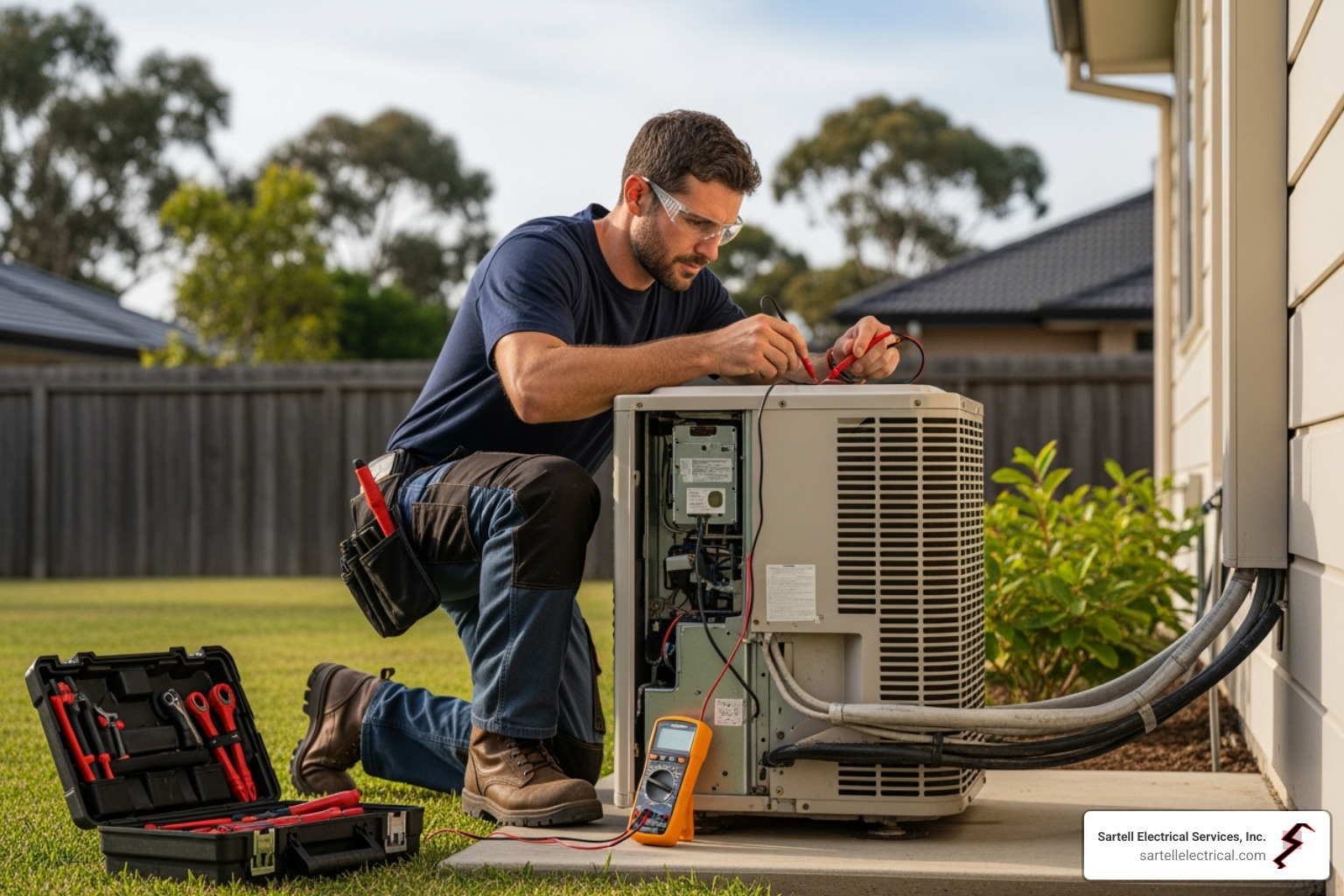
- Complex Diagnostics: Technicians use specialized tools like multimeters to pinpoint the exact cause of failure, avoiding guesswork.
- Code Compliance: Professional repairs ensure all work meets local and national electrical codes, preventing fire and shock hazards. You can find a licensed residential electrician who knows these codes inside and out.
- Warranty Protection: Most manufacturers require repairs to be done by licensed professionals to keep your warranty valid.
The Dangers of Improper AC Electrical Repair
Attempting a DIY electrical repair can lead to serious consequences:
- Fire Hazards: Incorrect wiring or loose connections can cause overheating and fires.
- Personal Injury: The voltage in your AC can cause severe burns or be fatal. For more information on home electrical safety, resources from the Electrical Safety Foundation International (ESFI) are invaluable.
- More Expensive Damage: A simple mistake can turn a $200 capacitor job into a $2,000 compressor replacement by damaging other components.
- Legal Liability: If an improper repair causes a fire or injury, your homeowner's insurance may not cover the damages.
When it comes to
AC electrical repair, calling a professional is the smart, safe choice for your home and family.
The Financial Breakdown: Costs, Prevention, and Replacement Decisions
Understanding the financial side of
AC electrical repair helps you make smart choices. The average repair can range from $600 to $3,500, but the cost depends heavily on which component failed.
| Electrical Repair Component |
Typical Cost Range (Parts + Labor) |
| Capacitor Replacement |
$100 - $400 |
| Contactor Replacement |
$150 - $500 |
| Circuit Board Replacement |
$400 - $1,200+ |
| Wiring Repair (Minor) |
$100 - $300 |
| Thermostat Replacement |
$150 - $450 |
Estimating the Cost of Common AC Electrical Repairs
Fortunately, the most common failures are also the least expensive.
- Capacitor and Contactor Replacement: These repairs typically cost between $100 and $500. While the parts are cheap, you're paying for a professional's expertise to diagnose the issue and handle high-voltage components safely.
- Circuit Board Replacement: This is a more expensive repair, often costing $400 to over $1,200. The boards themselves are costly, and proper installation is critical.
If your home's electrical panel is outdated, you might also need to consider a
main panel upgrade to safely support your system.
The '5000 Rule': Deciding to Repair or Replace
When facing a costly repair on an older system, should you fix it or replace it? The
5000 rule offers a practical guideline: multiply your AC unit's age by the estimated repair cost. If the total exceeds $5,000, replacement is likely the better financial choice.
- Example: For a 12-year-old unit needing a $500 repair (12 x $500 = $6,000), replacement is recommended.
- Example: For a 5-year-old unit needing the same $500 repair (5 x $500 = $2,500), repair makes sense.
This rule works because it accounts for the unit's remaining lifespan. An average AC lasts 10-15 years. Investing heavily in an older unit is often not cost-effective. Frequent breakdowns, rising energy bills, and the use of old R-22 refrigerant are other signs that it's time to replace your unit. For information on modern, efficient systems, check out our guide on
building electrical maintenance.
How Regular Maintenance Prevents Electrical Problems
Most
AC electrical repairs are preventable. Annual preventative maintenance is like an oil change for your car—it's essential for long-term health. During a tune-up, a technician will:
- Test capacitors and contactors for wear.
- Inspect wiring for damage.
- Clean components to prevent overheating.
- Tighten electrical connections loosened by vibration.
Catching these issues early saves you from emergency breakdowns and extends your system's lifespan, protecting your investment.
Frequently Asked Questions about AC Electrical Repair
Over my nearly four decades in the business, certain questions about
AC electrical repair come up again and again. Here are the most common ones.
How long do AC capacitors last?
Most AC capacitors last 5 to 10 years. Their lifespan is affected by extreme temperatures, power surges, and how often your AC cycles. Some professionals recommend replacing capacitors proactively every five years to prevent a sudden failure during a heat wave and to avoid the stress a failing capacitor puts on other expensive components.
Can a bad capacitor damage my AC compressor?
Yes, a failing capacitor can absolutely damage your compressor, the most expensive part of your AC unit. When a capacitor is weak, it can't give the compressor the boost it needs to start. The compressor then struggles and overheats, leading to premature failure. Replacing a compressor can cost thousands, so spending a few hundred dollars to replace a weak capacitor is a smart preventative investment.
Why does my AC unit keep tripping the circuit breaker?
A tripping breaker is a safety device telling you something is wrong. Common causes include:
- An overloaded circuit: The AC is drawing more power than the circuit can handle.
- A short circuit: Damaged or frayed wires are making contact.
- A failing component: A struggling compressor or fan motor can draw excessive current.
- A severely clogged air filter or dirty coils: This forces the unit to work much harder, drawing more power.
If your breaker trips repeatedly, do not keep resetting it. This is dangerous and can cause a fire or damage your AC unit. Leave the breaker off and call a
professional electrician to diagnose the problem safely. Our
electrical troubleshooting cost guide can provide more information on diagnostic services.
Conclusion
A functioning air conditioner is essential during a Massachusetts summer. We've walked through the electrical heart of your AC system so you can recognize the signs of trouble.

The most important takeaway is that
safety always comes first. While you can change an air filter,
ac electrical repair involves high-voltage components that are dangerous for DIY attempts. A seemingly simple capacitor replacement can cause a severe shock or fire if handled improperly.
If your AC won't start, trips the breaker, hums, or has a burning smell, you need expert help. Trying to fix it yourself can turn a minor repair into a major expense or a safety hazard.
At
Sartell Electrical Services, we've been solving electrical challenges for Massachusetts homeowners since 1985. When your AC goes down, you need an expert who can diagnose the problem accurately and fix it right the first time. Our licensed electricians have the experience and equipment to get your system back online safely.
Don't let an electrical problem leave you sweating. Contact us today for expert diagnosis and repair, and see why homeowners throughout Reading and the Greater Boston area trust us with their critical electrical needs.
Learn about our comprehensive electrical maintenance services to keep your systems running smoothly year-round.