
What is the standard residential electrical service size – this is a question every homeowner should know the answer to. Most modern homes have either 100-amp or 200-amp electrical service, with 200 amps being the current standard for new construction and renovations.
Quick Answer:
Your electrical service size determines how much power flows into your home – think of it as the main pipeline for electricity. This capacity, measured in amperes (amps), affects everything from whether your lights dim when the AC kicks on to whether you can safely add that electric vehicle charger you’ve been considering.
The electrical service consists of three key components: the service entrance cable bringing power from the utility, the electrical meter measuring your usage, and the main electrical panel distributing power throughout your home. The smallest rated component among these three determines your actual service capacity.
As Ed Sartell, President of Sartell Electrical Services since 1985, I’ve helped thousands of Massachusetts homeowners understand what is the standard residential electrical service size for their specific needs. With nearly four decades of experience upgrading electrical systems, I’ve seen how proper electrical capacity keeps homes safe and ready for modern demands.
To understand what is the standard residential electrical service size, you need to know about amperage (volume of electricity) and voltage (electrical pressure). Most Massachusetts homes have 120/240-volt service. Standard outlets use 120 volts for small items, while major appliances like dryers and air conditioners use 240 volts. Higher amperage means your home can power more devices at once without an overload.
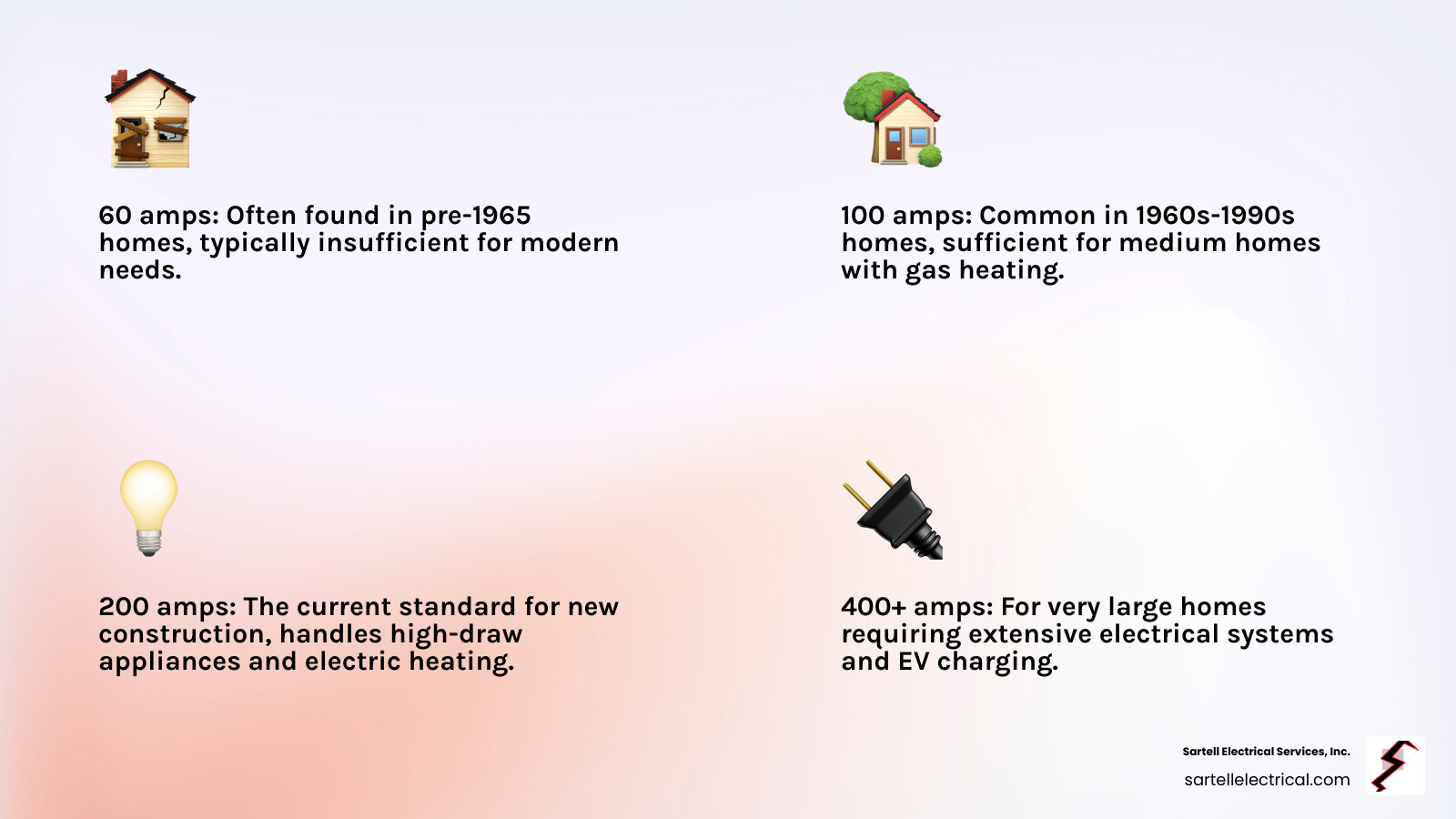
The National Electrical Code (NEC) sets the minimum service size at 100 amps for single-family homes. However, meeting the minimum is different from meeting your actual needs.
Here’s how the common residential service sizes stack up:
| Service Size (Amps) | Typical Home Size/Age | Appliance Capacity | Common Use Cases |
|---|---|---|---|
| 60 Ampere | Very old homes (pre-1965), small apartments | Basic lighting, a few small appliances, often only 120V (older fuse panels) | Homes with minimal electrical needs, often requiring immediate upgrade |
| 100 Ampere | Older to mid-century homes (1960s-1990s), smaller modern homes | Standard appliances, gas heating/water heater/dryer | Adequate for smaller homes, or those where major electrical loads are gas-powered |
| 150 Ampere | Modern minimum for some homes | Increased capacity for more appliances, central AC | Becoming a typical minimum for modern homes, especially with some electric loads |
| 200 Ampere | New construction, larger modern homes, renovated homes | All standard appliances, electric heating/water heater/dryer, EV charging, hot tubs | The current standard, offering ample room for growth and modern electrical demands |
| 400+ Ampere | Very large custom homes, homes with extensive electric heating, multiple large systems | Multiple high-demand appliances, dual HVAC, large workshops, home businesses | Rare, typically only for homes with exceptionally high electrical loads |
The answer to what is the standard residential electrical service size has evolved with our electrical needs.
In the 1950s, a 60-amp fuse panel was sufficient for basic appliances. From the 1960s to the 1990s, 100-amp service became the norm and is still common in homes with gas appliances.
Today, 200-amp service is the clear standard for new construction. It safely handles modern demands—from EV chargers to smart homes—and is the smart choice for future-proofing, as the installation cost difference between 100 and 200 amps has narrowed.
At Sartell Electrical Services, we regularly upgrade older Massachusetts homes from 60-amp or 100-amp panels to 200-amp systems to safely accommodate today’s lifestyle and meet current code requirements.
More info about residential electrical services
A common point of confusion is the difference between a main panel and a subpanel.
Your main electrical panel receives power from the utility, and its amperage rating determines your home’s total capacity.
A subpanel is an extension of the main panel, adding more circuit breaker slots for areas like a garage or addition.
Crucially, a subpanel adds circuit space but does not increase your home’s total amperage. A 100-amp main service with a subpanel still only provides 100 amps of total power. To truly increase capacity, a main service upgrade is required.
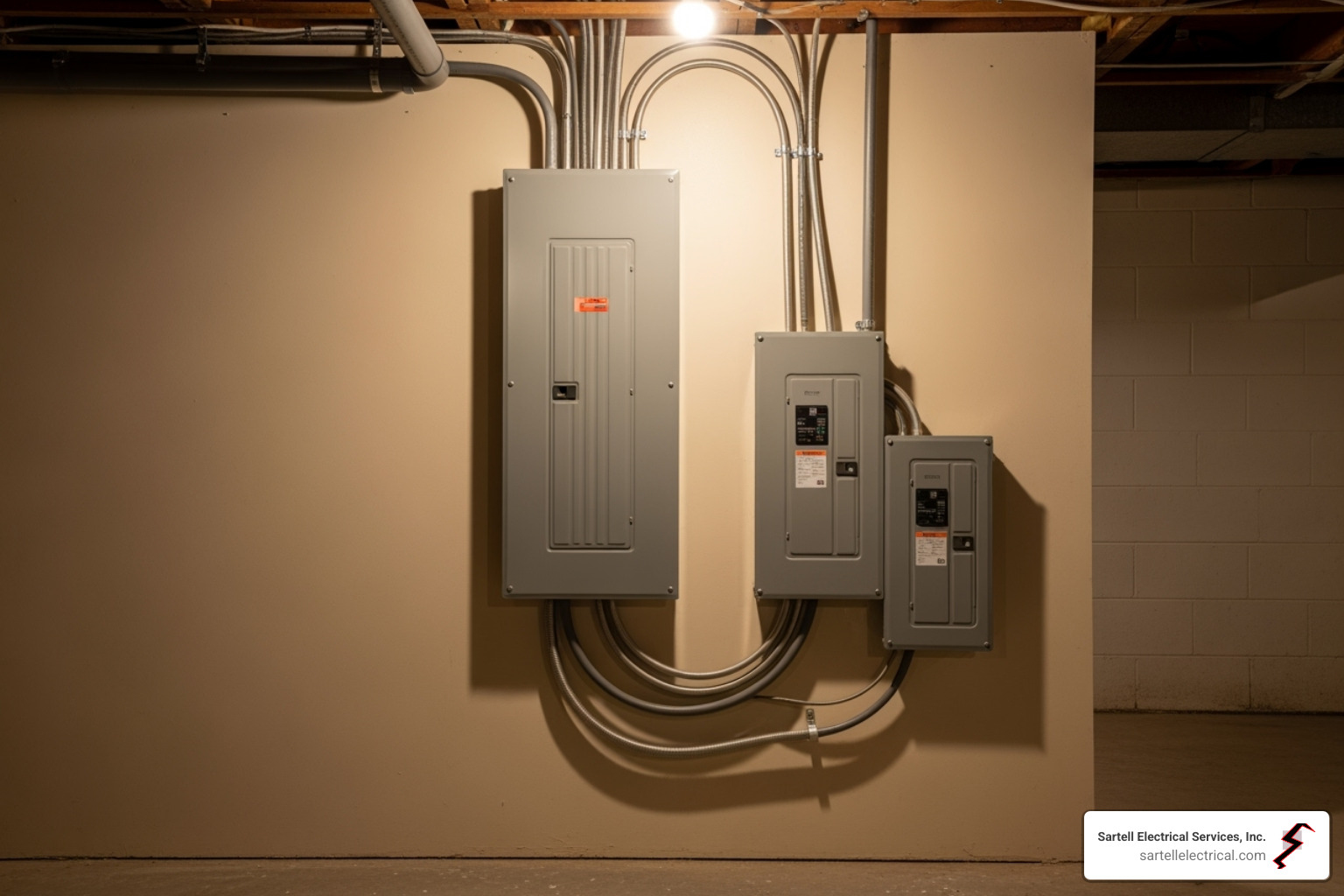
You can determine your home’s electrical service size with some simple detective work, but always consult a qualified electrician for a definitive answer. Here are clues you can gather safely on your own.
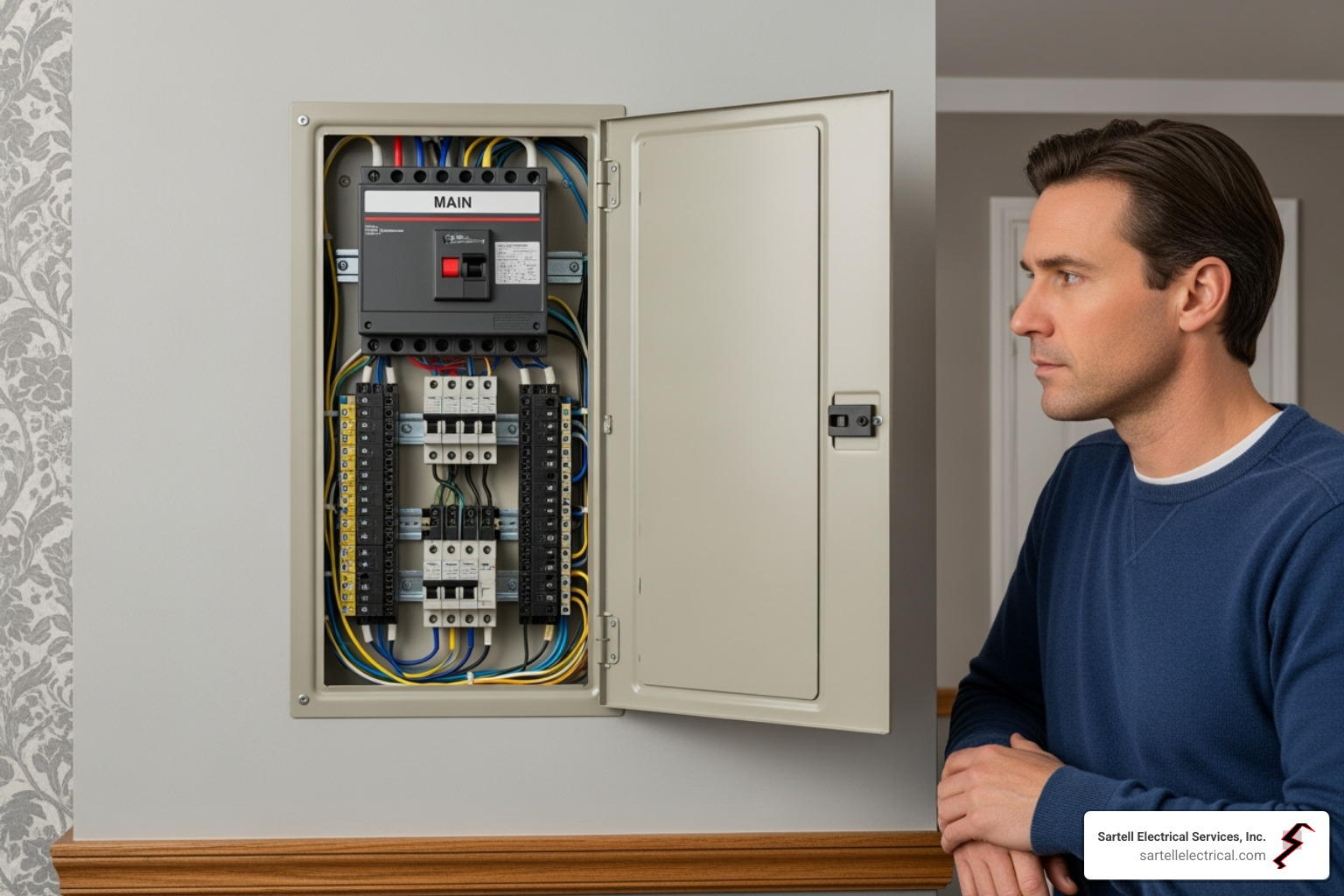
Your actual service capacity is only as strong as its weakest link. The true size is determined by the component with the lowest rating among your main breaker, service entrance cables, and electrical panel.
Here’s how to check:
Locate your main electrical panel. It’s a gray metal box usually found in a basement, garage, or utility closet.
Read your main breaker. Open the panel’s inner door (never remove the main cover). The main breaker is the largest switch, often labeled “Main,” with its amperage (e.g., “100” or “200”) stamped on the handle.
Check for panel labels. Stickers inside the door often list the panel’s maximum amperage rating.
Look at your electrical meter. The meter outside your home may have its rating printed on the face (e.g., “CL200” for 200 amps).
Observe the service entrance components from a distance. The thickness of the cables and the diameter of the conduit (pipe) protecting them can indicate service size. For safety, never touch these high-voltage components.
Your home will often give you warning signs when its electrical system is struggling.
A practical guide to understanding electrical load
Knowing what size your home needs requires a load calculation—a professional audit of your home’s electrical usage. This analysis considers your home’s size, layout, and all major appliances.
Modern specialty loads are often the biggest factor. An electric vehicle (EV) charger can draw 30-60 amps, and a hot tub requires 20-40 amps. These high-demand items can easily max out a 100-amp service.
Other considerations include electric heating systems, home workshops, or major renovations. The smart approach involves future-proofing your electrical service. Upgrading your service as part of a larger project is almost always more cost-effective than doing it as a standalone job later.
A convenient calculator tool for residential electrical load
Upgrading your home’s electrical service is a smart investment in safety and property value. While it may seem daunting, the process is straightforward with an experienced electrical contractor.
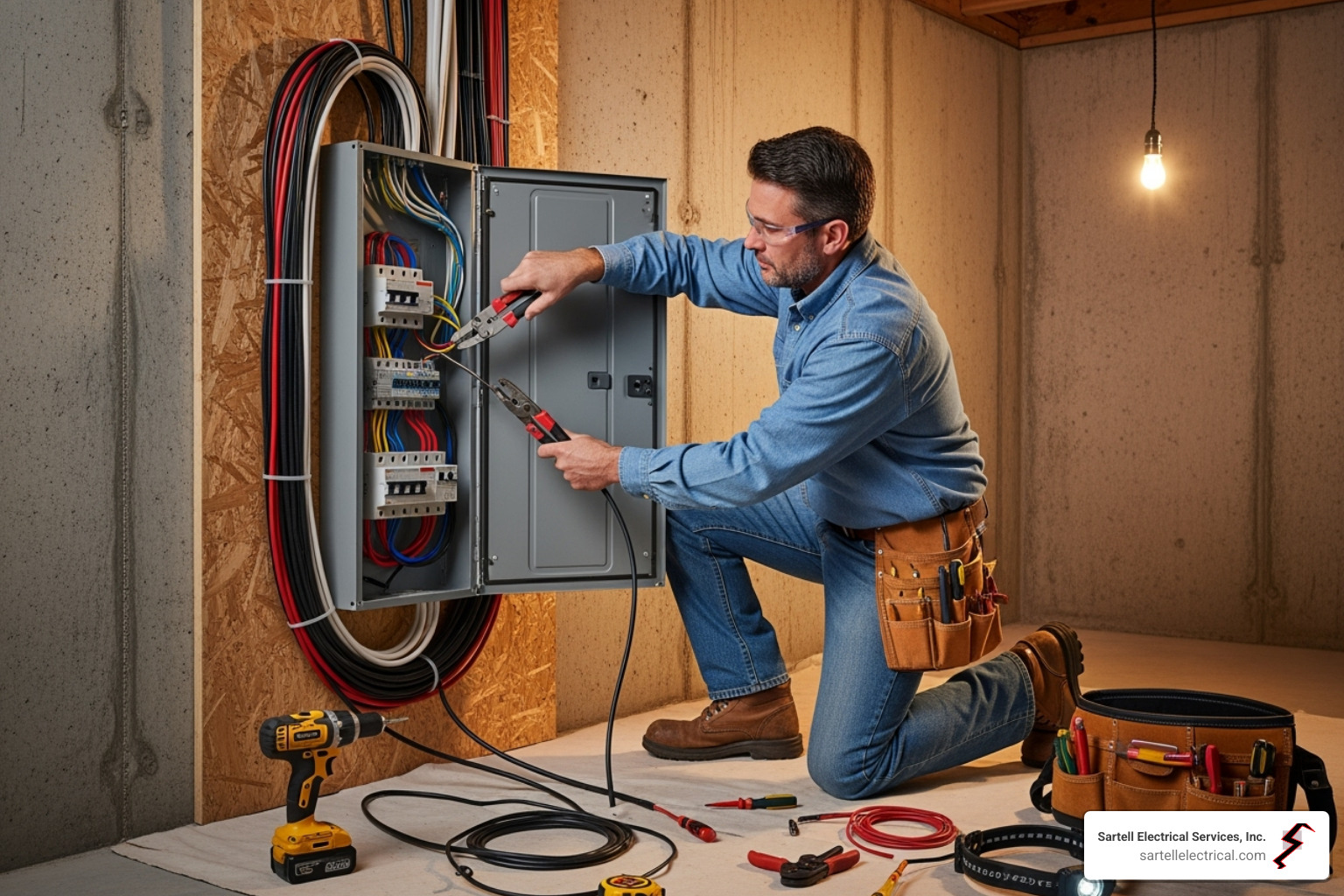
An upgrade typically involves replacing the service entrance cable, the electrical meter base, and the main electrical panel. This increases your home’s capacity to handle more power safely and efficiently.
The benefits are significant:
Our process at Sartell Electrical Services is designed to be seamless:
We guide you through every step with the clear communication and expertise we’ve been known for in Massachusetts for over 30 years.
More info about our electrical services
As Massachusetts homeowners learn more about their electrical systems, we hear the same questions come up time and again. After three decades of helping families upgrade their homes’ electrical capacity, these are the concerns that keep coming up in our consultations.
This is probably the most common question we get, and the answer depends on how you live. A 100-amp service can be adequate for smaller homes, particularly if major appliances like the furnace, water heater, and dryer run on natural gas.
However, if you have an all-electric home, plan to install an electric vehicle charger, or want a hot tub, a 100-amp service will likely be insufficient. Modern homes have more electrical demands than ever, from multiple computers to smart home devices. A 200-amp service provides the necessary breathing room and future-proofs your home, so you don’t have to worry about tripping breakers when running multiple appliances.
The final cost depends on several factors, but a typical upgrade for a single-family home generally ranges from $3,000 to $6,000 or more. Key variables include:
This is why we provide a thorough on-site assessment to give you an accurate, upfront quote with no surprises.
I’m going to be very direct here: absolutely not. This is a matter of safety. Electrical service upgrades involve working with high-voltage power directly from the utility grid, which can be fatal.
The risks of DIY work include electrocution, electrical fires, and damage to your appliances and home’s wiring. Furthermore, in Massachusetts, this work legally requires permits and inspections that can only be handled by a licensed electrician to ensure it meets all safety codes. This is not a DIY project. For your safety and to protect your property, always hire a professional with the training, tools, and insurance to do the job correctly.
Knowing what is the standard residential electrical service size is about ensuring your home is safe and ready for the future. Whether you have a struggling 60-amp system, an adequate 100-amp setup, or a robust 200-amp service, understanding your capacity puts you in control. Our homes are more electric than ever, with smart devices, security systems, and electric vehicles adding to the load. An older panel might be working overtime just to keep up.
A professional assessment is crucial. A licensed electrician can perform an accurate load calculation, spot hidden dangers, and help you plan for future electrical demands. Thinking about an EV or a hot tub down the road? Planning for that capacity now saves money and future frustration.
At Sartell Electrical Services, we’ve been helping Massachusetts homeowners understand and upgrade their electrical systems since 1985. From the historic homes in Reading to the newer developments in Andover, we’ve seen it all. Our experience across Essex County, Middlesex County, and Greater Boston means we know exactly what it takes to bring your home’s electrical system up to modern standards.
Don’t wait for the warning signs to become emergencies. Flickering lights and tripping breakers are your home’s way of asking for help. With a professional assessment and upgrade, your electrical worries can become a thing of the past.
Your home should work for you, not against you. When your electrical system has the capacity it needs, everything just works better – from the morning coffee maker to the evening movie night, from charging your devices to powering your dreams.
Contact us for a professional assessment and let us help you ensure your home is safely and efficiently powered for today and tomorrow.

236 Ash St Reading, MA 01867
(By Appointment Only)
