

MA electricians must obtain licensing through the Massachusetts Board of State Examiners of Electricians to legally perform electrical work. This system protects public safety while establishing clear career advancement paths for professionals in the trade.
There are four main Massachusetts electrician license types:
The Board of State Examiners of Electricians regulates all electrical work in Massachusetts, from residential repairs to complex commercial installations. This framework ensures that only qualified professionals handle the electrical systems that power our homes and businesses.
Understanding the licensing requirements is essential, whether you’re starting an electrical career, expanding your business, or hiring a contractor. Each license has specific education, experience, and examination requirements that must be met.
I’m Ed Sartell, and I’ve been working with MA electricians and navigating the state’s licensing requirements since founding Sartell Electrical Services in 1985. With nearly four decades in the trade, I understand the challenges and opportunities that proper licensing creates for professionals and the clients who depend on their expertise.
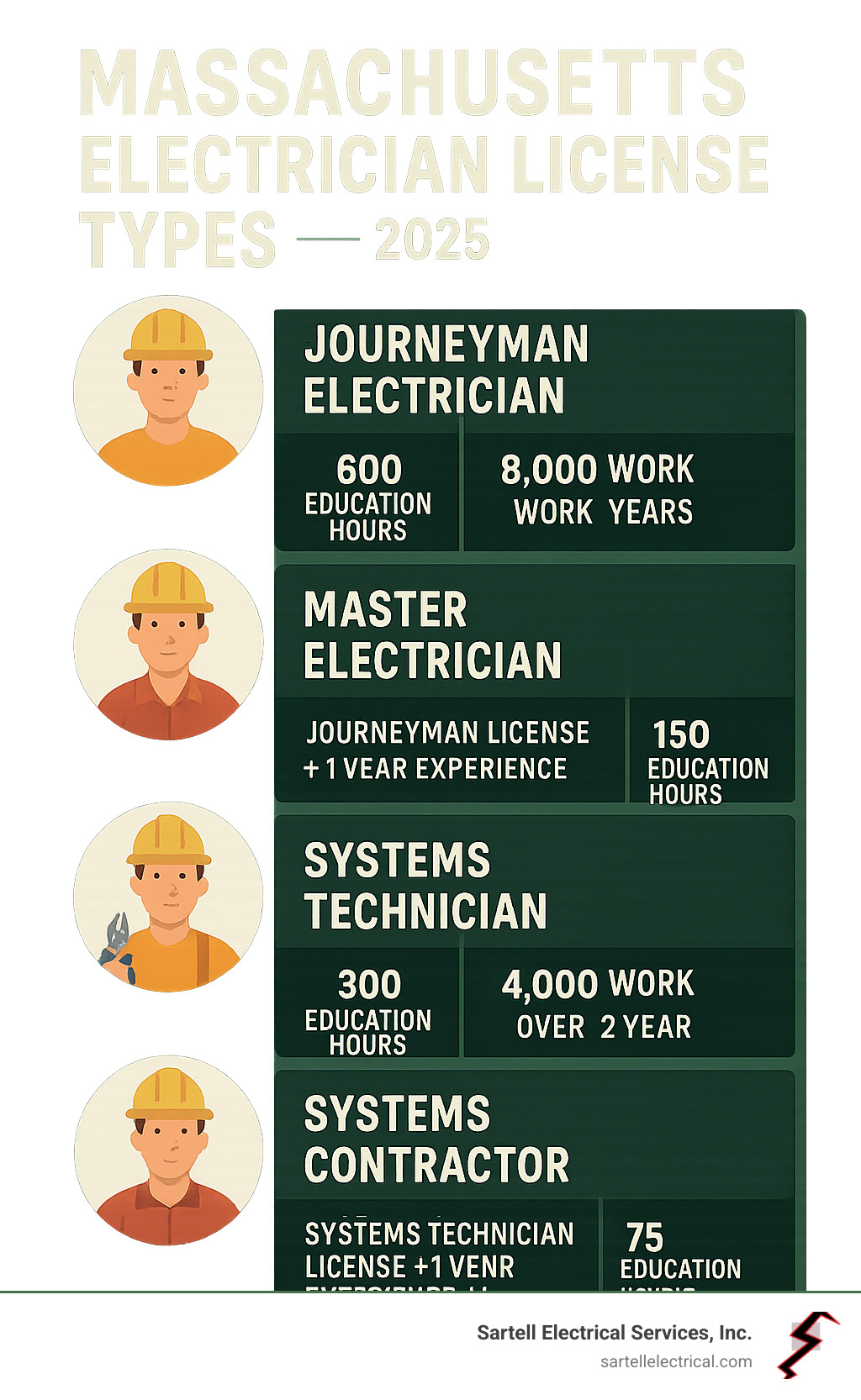
The Massachusetts electrical trade operates on a structured licensing system with four distinct license types, each building upon the previous level of expertise. Understanding these requirements is crucial for any electrical professional in the state.
The Journeyman Electrician license is the starting point for most MA electricians. This Class B license allows you to perform electrical work in all settings under the supervision of a Master Electrician.
To qualify, you need:
As a Journeyman, you’ll handle diverse projects, from residential troubleshooting to assisting with commercial installations, building the foundation for a successful career. For those interested in this work, you can find more info about residential electrical work to see the opportunities.
The Master Electrician license (Class A) is the highest individual certification in Massachusetts, allowing you to pull permits, supervise other electricians, and operate a contracting business.
The requirements build on the Journeyman license:
Master Electricians oversee entire projects, ensure code compliance, and manage teams. This license opens doors to larger installations and business ownership. To see the scope of such projects, explore commercial electrical contracting.
The Systems Technician license (Class C) is for specialists in low-voltage systems like fire alarms, security systems, and data networks.
Specific requirements for this field include:
Systems Technicians are essential for installing and maintaining the connected infrastructure in modern buildings.
The Systems Contractor license (Class D) is the business-level certification for low-voltage work, similar to a Master Electrician but for specialized systems.
To qualify, you must:
Systems Contractors design and implement the complex low-voltage networks that power today’s smart buildings.
Once you’ve completed the required education and experience, the final step is navigating the application and examination process. This stage requires careful attention to detail, dedicated study, and an understanding of the costs involved.
The application process is managed by a third-party vendor, PSI, to ensure all candidates meet the Board’s high standards.
Before applying, ensure you have completed all required education and work experience hours, including the 15-hour Code-Update Class for Journeyman or Systems Technician applicants.
You will need to gather several documents, including:
Many of these forms require a notary public’s seal. Once complete, submit your application packet to PSI via email or mail. PSI will review your application and, upon approval, allow you to schedule your exam. Always keep copies of everything you submit. This meticulous process ensures that only qualified and vetted professionals become licensed MA electricians. You can begin your application here: Submit your application to PSI.
Pursuing your license involves financial costs for application processing and exam administration. The total fees for initial exam applications are:
These fees typically cover the PSI application, exam administration, and the state processing fee. The re-examination fee is $135 if you need to retake any portion of the exam.
Under the Valor Act, Massachusetts waives the state application processing fee for military personnel, veterans, and their spouses. Be sure to include your DD214 or Military Spouse Affidavit to receive this benefit. Payments are typically made by Money Order or Cashier’s Check, though credit card information may be accepted with the application.
The exams for MA electricians are challenging to ensure only competent and knowledgeable individuals are licensed. It is not uncommon for candidates to take the exam multiple times, so persistence and thorough preparation are key.

Exams include a theory (written) portion and sometimes a practical portion. The written exams are often “open-book,” but this requires you to steer the National Electrical Code (NEC) quickly and efficiently under timed conditions. Key challenges include code interpretation and electrical calculations.
To improve your chances of success:
Essential study materials include the latest NEC, Massachusetts statutes, a non-programmable calculator, and exam prep guides.
Massachusetts has a specific reciprocity agreement only with New Hampshire. If you are licensed in New Hampshire, you may be able to obtain a Massachusetts license without re-taking the exam, but it is not an automatic process. You must review the specific eligibility requirements and regulations.
The application for reciprocal licensure is submitted through the state’s ePLACE portal. For those with experience from other states or countries, your credentials will undergo a thorough review to ensure they meet Massachusetts standards for public safety.
Earning a Master Electrician license signifies a transition into a leadership role with significant authority and responsibility. It moves beyond technical skill to encompass project oversight, business management, and mentorship.
A Master Electrician in Massachusetts is responsible for the entire scope of an electrical project. Key duties include:
At Sartell Electrical Services, our Master Electricians lead a wide range of projects, from hospital installations to industrial automation. You can see the breadth of this work by exploring our Learn about our project portfolio.
The Board of State Examiners of Electricians enforces strict rules to ensure professional conduct and public safety.

Key prohibitions include:
The Board actively investigates complaints and can impose penalties ranging from fines to license revocation.
Different jurisdictions have varying approaches to electrical licensing. Comparing Massachusetts to Ontario, Canada, highlights some of these differences.
| Feature | Massachusetts Master Electrician (Class A) | Ontario Master Electrician (ME) |
|---|---|---|
| Prerequisites | MA Journeyman Electrician license | At least 18 years old |
| Experience | 1 year as a licensed MA Journeyman | Minimum 3 years as a journeyperson electrician or equivalent |
| Education | 150 hours of post-Journeyman education | No specific pre-exam hours; training required after two failed exams |
| Exam Focus | Advanced theory, code, and business practices | Ontario Electrical Safety Code (33%), Worker Safety (33%), Business Administration (33%) |
| Business/Technical Role | Authorizes supervision and permit-pulling, often leading to business ownership | Required to operate or be a Designated Master Electrician for an Electrical Contracting Business |
| Regulatory Body | MA Board of State Examiners of Electricians | Electrical Safety Authority (ESA) |
While the paths differ in experience and education requirements, both systems aim to produce professionals capable of safely leading projects and protecting the public. Both also require additional licensing for an individual to operate as an independent contractor.
Earning your electrician’s license is a major accomplishment, but it’s not a one-time event. To remain an active MA electrician, you must stay current with continuing education and know how to access resources from the Board of State Examiners of Electricians.
The electrical field is constantly evolving with new technologies and updated safety codes. To ensure all licensed MA electricians remain competent, Massachusetts requires ongoing training.
Licensed electricians must complete 21 hours of continuing education during each three-year license cycle. This is divided into two parts:
This system ensures that professionals stay sharp and informed about critical safety and industry standards.
Continuing education courses must be taken from providers officially approved by the Board. This ensures the information is accurate and meets state standards.

The official website of the Board of State Examiners of Electricians provides an updated list of approved schools and CE providers. The site is also a valuable resource for all MA electricians, containing:
Bookmarking the official Board website is the best way to stay compliant and well-informed. You can Visit the Board of State Examiners of Electricians to access these resources.
The Board provides public tools to verify an electrician’s credentials and file a complaint if necessary, which helps protect consumers.
To check if an MA electrician is properly licensed, use the online license lookup tool available on the state’s ePLACE portal or the Division of Occupational Licensure’s website. You can search by name or license number to confirm their status is in good standing.
If you encounter unprofessional conduct or faulty work, you have the right to file a complaint. The process involves:
Information about disciplinary actions taken against licensed MA electricians is often available through public records requests, ensuring transparency and accountability.
The path to becoming a licensed MA electrician is demanding, but it is a worthwhile journey that establishes a foundation of safety, knowledge, and professionalism. From the initial education for a Journeyman to the leadership responsibilities of a Master Electrician, each step creates professionals who are experts in their craft.
This guide has outlined the four license types, the application and exam process, and the ongoing requirements for maintaining a license. The system is not designed to be a barrier but to ensure that all electrical work in the Commonwealth is performed safely and correctly.
The 21-hour continuing education requirement underscores that our field is constantly evolving. Lifelong learning is a commitment that ensures MA electricians remain at the forefront of technology and safety practices.
At Sartell Electrical Services, we have built our reputation on these principles of excellence and safety for over three decades. We believe that excellence isn’t negotiable when it comes to electrical work. Every project deserves the highest level of attention to detail and commitment to safety.
For those starting their careers, accept the process. For businesses and homeowners, understanding these requirements helps you hire a true professional. When you hire a licensed MA electrician, you are investing in someone who has dedicated years to mastering their trade and adhering to the latest safety standards.
Our team of licensed professionals brings decades of combined experience to every project, backed by the rigorous training and ongoing education the state requires. It’s what allows us to tackle any challenge with confidence.
Ready to work with licensed professionals who do things right? We invite you to View our service area and contact us for your next project. Our licensed MA electricians are ready to deliver the quality and safety you deserve.

236 Ash St Reading, MA 01867
(By Appointment Only)
