

Hospital electrical services encompass the specialized design, installation, and maintenance of electrical systems that power critical medical equipment and ensure the safe operation of healthcare facilities. These services include:
In healthcare facilities, electrical systems serve as more than just infrastructure – they act as a vital organ that provides power, lighting, climate control, and communication systems necessary to keep medical institutions running. As the research reveals, “electrical systems in hospitals are more complex than those found in other buildings,” with reliability being paramount since every second can mean the difference between life and death.
The stakes couldn’t be higher. When electrical systems fail in hospitals, the consequences extend far beyond inconvenience. Life-support equipment shuts down, surgical procedures halt, and critical diagnostic tools become useless. This complexity demands specialized expertise that understands both the technical requirements and the human impact of electrical infrastructure in healthcare settings.
I’m Ed Sartell, and I’ve been leading electrical projects across Massachusetts for nearly four decades, including specialized work in healthcare facilities where Hospital electrical services require the highest standards of safety and reliability. My team and I understand that in medical environments, there’s simply no room for electrical failures or shortcuts.
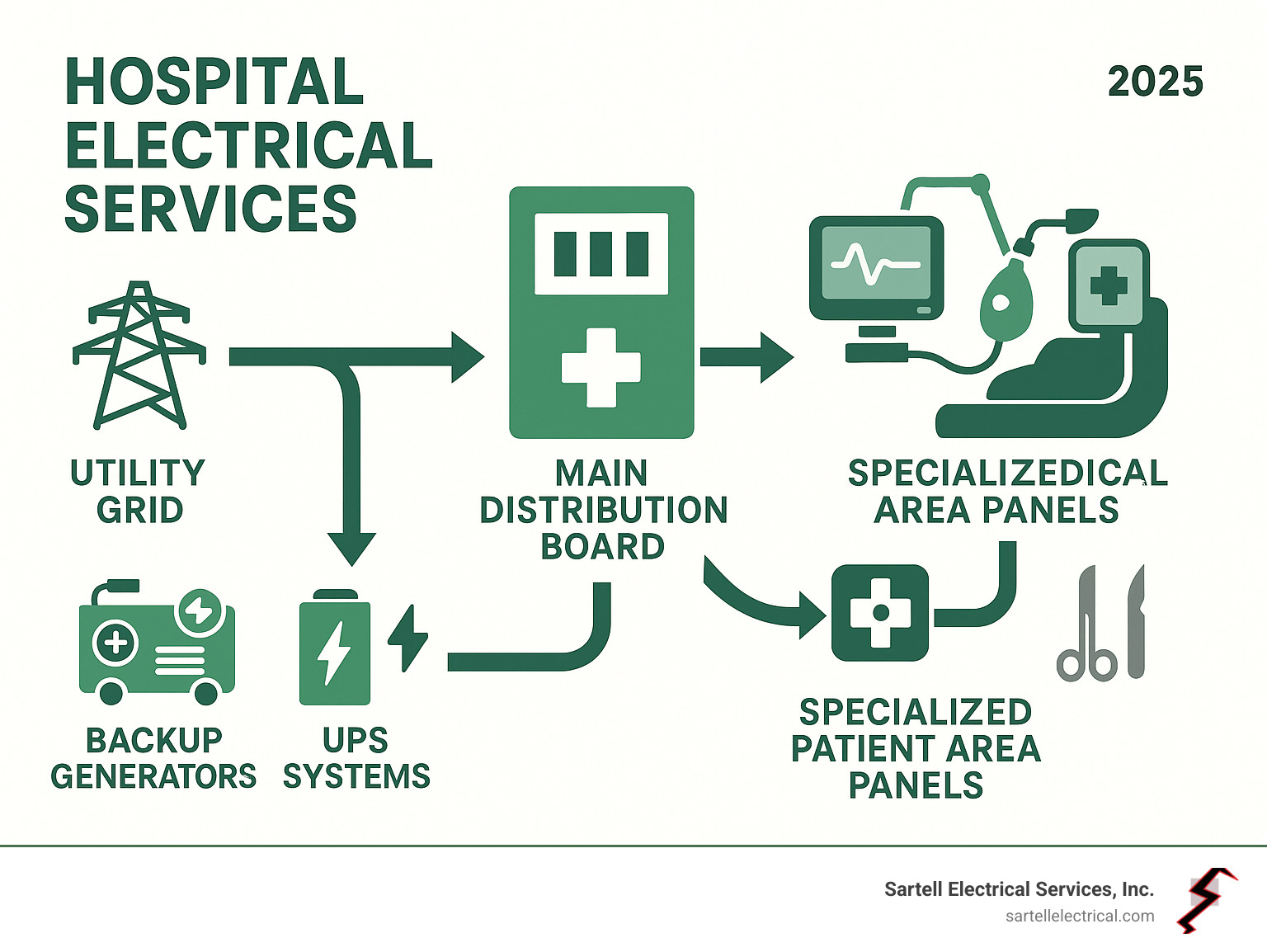

Picture this: You’re in a hospital operating room where a surgeon is performing a delicate procedure. The bright surgical lights illuminate every detail, monitors beep steadily with vital signs, and life-support equipment hums quietly in the background. What makes this life-saving scene possible? Hospital electrical services that ensure every piece of equipment receives the clean, reliable power it needs.
In healthcare facilities, electrical systems do far more than keep the lights on. They power life-support systems that keep patients breathing, ensure medical imaging equipment reliability for accurate diagnoses, and maintain diagnostic machinery accuracy that doctors depend on every day. When these systems work perfectly, patients and staff stay safe, and the complex infrastructure that makes modern medicine possible continues operational continuity without a hitch.
At Sartell Electrical Services, we understand that hospital electrical work isn’t just another commercial project – it’s about protecting lives. That’s why our team specializes in the unique demands of healthcare facilities. Learn more about our comprehensive commercial electrical services designed for critical environments.
Here’s something that might surprise you: the difference between a perfect MRI scan and a blurry one often comes down to power quality. Medical equipment is incredibly sensitive, and even small voltage fluctuations can throw off results or damage expensive machines.
Think about the sensitive electronics in a modern hospital. MRI and CT scanners need rock-steady power to create clear images that help doctors spot problems. Ventilators must run without interruption to keep patients breathing. ECG monitors require clean electrical signals to accurately track heart rhythms.
When power isn’t stable, several problems can happen. Diagnostic equipment might give false readings, leading to preventing diagnostic errors becoming a real challenge. Voltage spikes can damage circuit boards that cost thousands to replace. Poor power quality can also shorten equipment life, which is why extending equipment lifespan through proper electrical design is so important.
We’ve seen hospitals spend hundreds of thousands on new medical equipment, only to have power quality issues cause constant headaches. That’s why we focus on installing specialized surge protection and power conditioning systems that keep these sensitive machines running smoothly.
Beyond individual pieces of equipment, reliable power distribution keeps entire hospital departments functioning. The HVAC systems that maintain perfect temperatures in operating rooms and prevent infections need consistent power. Communication networks that let doctors and nurses coordinate patient care can’t afford to go down.
Then there are the safety systems that protect everyone in the building. Fire alarm systems need power to detect smoke and alert staff to evacuate patients safely. Emergency lighting guides people through dark hallways when the main power fails. These systems work together to create what we call minimizing downtime – ensuring that critical hospital operations never stop.
What really matters is safeguarding lives. Every electrical component we install, from the main distribution panels to the outlet next to a patient’s bed, plays a role in keeping people safe. When electrical systems fail in hospitals, it’s not just an inconvenience – it can be a matter of life and death.
That’s why hospital electrical work requires specialized knowledge and experience. The stakes are simply too high for anything less than perfection.

When I walk into a hospital’s electrical room, I see more than just panels and wires. I see the beating heart of the entire facility. These aren’t your typical electrical components – they’re precision-engineered systems that literally keep people alive. Every circuit, every switch, every backup system has been carefully designed to ensure that power flows exactly where it’s needed, exactly when it’s needed.
The complexity here is staggering. Unlike a typical office building where a brief power interruption might just restart a few computers, Hospital electrical services require systems that can handle the most demanding and critical loads imaginable. Power distribution, electrical panels, backup power systems, Uninterruptible Power Supply (UPS) units, and generators all work together to create what we call system resilience.
Think of electrical panels as the traffic controllers of a hospital’s power grid. They don’t just distribute electricity – they make smart decisions about where that power goes and how it gets there safely. Research shows that “they represent a critical and necessary component in all hospital infrastructures because they allow the distribution of energy in each consumption line.”
Main Distribution Boards (MDB) serve as the primary gateway where utility power enters the hospital. From there, the electricity flows to subpanels (SDB) that feed specific departments or floors. But here’s where hospitals get really interesting – we also install emergency panels that are dedicated exclusively to life-critical equipment.
The real magic happens with Automatic Transfer Switches (ATS). These intelligent devices constantly monitor the utility power, and the moment they detect a problem, they seamlessly switch critical loads to backup power. It’s like having a vigilant guardian that never sleeps, never takes a break, and reacts faster than any human could.
Circuit breakers and fuses might seem basic, but in a hospital setting, they’re protecting far more than equipment – they’re protecting lives. Every protective device is carefully sized and selected to prevent electrical hazards while ensuring that critical systems stay online. You can learn more about the key components of distribution panels and how they work together.
Here’s the truth about hospital power: failure is not an option. When the lights go out in your home, it’s an inconvenience. When power fails in an operating room, lives hang in the balance. That’s why backup power systems aren’t just recommended in healthcare – they’re absolutely essential.
Uninterruptible Power Supply (UPS) systems provide immediate power the instant utility power fails. We’re talking about battery-powered systems that kick in so fast that sensitive medical equipment never even knows there was a problem. For critical areas like operating rooms and Intensive Care Units (ICUs), we typically install UPS systems that can provide anywhere from 15 minutes to several hours of clean, stable power.
But UPS systems are just the first line of defense. For long-term power outages, generators take over the heavy lifting. These robust machines, usually diesel-powered, can run for days or even weeks if needed. We design these systems with adequate fuel storage – typically a day tank that provides 10 hours of operation and a bulk tank that can keep things running for over 200 hours.
The beauty of this system is in the seamless transition. When utility power fails, the UPS immediately takes over. Within seconds, the generator starts up and begins carrying the load, allowing the UPS batteries to recharge. This multi-layered approach means that critical loads in operating rooms, ICUs, and data centers never experience even a momentary interruption.
What really matters is that this entire system works together as one integrated unit. Every component – from the smallest circuit breaker to the largest generator – is designed to protect what matters most: the patients who depend on these systems for their very lives.

When it comes to hospital electrical services, safety isn’t just important—it’s everything. In my nearly four decades of electrical work, I’ve learned that hospitals demand a level of precision and care that goes far beyond typical commercial projects. Every wire, every connection, every safety device must be perfect because lives literally depend on it.
The reality is sobering: even the smallest electrical fault in a healthcare setting can have devastating consequences. A momentary power fluctuation could disrupt a ventilator. An improper ground could cause a shock to a vulnerable patient. A fire from faulty wiring could endanger an entire ward. That’s why we approach every hospital electrical services project with the understanding that we’re not just installing electrical systems—we’re protecting human lives.
Healthcare facilities operate under some of the most rigorous electrical standards in the world, and for good reason. These aren’t bureaucratic problems; they’re carefully crafted safety nets that have evolved from decades of experience and, unfortunately, past tragedies.
The foundation of our work starts with NFPA 99, also known as the Health Care Facilities Code. This comprehensive standard is like the bible for hospital electrical work. It covers everything from basic wiring methods to complex essential electrical systems, and it’s designed with one goal in mind: minimizing the hazards of fire, explosion, and electrical shock in healthcare environments.
Working alongside NFPA 99 is NFPA 70, the National Electrical Code that forms the baseline for all electrical safety in the United States. In hospitals, these two codes work together, with NFPA 99 often adding even stricter requirements to the NEC’s foundation.
We also steer Joint Commission standards, which may not be electrical codes themselves, but they enforce compliance with these safety standards as part of their accreditation process. Hospitals need this accreditation to operate, making compliance absolutely essential.
Every project involves meticulous attention to grounding and bonding throughout the facility. This isn’t just about following code—it’s about creating multiple layers of protection against electrical shock, especially in areas where moisture and medical equipment create higher risks. Regular inspections and adherence to specific wiring methods aren’t suggestions in our line of work; they’re non-negotiable requirements that we take seriously.
Not all hospital spaces are created equal when it comes to electrical safety. Some areas require extraordinary protection because patients may be more vulnerable to electrical hazards, or because the medical procedures performed there involve direct electrical contact with the body.
Body Protected Areas are patient spaces where medical procedures involving direct contact might occur. The electrical systems in these areas must meet specialized requirements, including compliance with standards that ensure the safest possible environment. These spaces feature specialized wiring and safety switches that are independent of the main power supply, designed to instantly cut and restore power if a fault occurs—all while preventing interruptions to life-sustaining equipment.
Even more critical are Cardiac Protected Areas, where invasive heart procedures take place. These zones require the highest degree of electrical safety to prevent microshock, which could be fatal to a patient whose heart is being directly monitored or treated.
In these ultra-sensitive areas, we often install isolated power systems. Unlike conventional grounded systems, these use isolation transformers to dramatically reduce the risk of electrical shock by limiting fault currents. It’s an additional layer of protection for patients who are most vulnerable to electrical hazards.
The attention to detail extends to every outlet and switch. Medical equipment outlets are clearly marked and dedicated to prevent the accidental use of non-compliant equipment. This ensures that critical medical outlets remain available for their intended life-saving purpose. Regular testing—typically every 12 months—ensures these systems continue to provide the protection they were designed for.
This level of specialized work requires deep knowledge and experience. Learn more about our specialized healthcare electrical services and how we can help protect your facility and patients.
Think of your car – you wouldn’t wait for the engine to seize before changing the oil, right? The same principle applies to Hospital electrical services, but with stakes that are infinitely higher. In healthcare facilities, electrical failures don’t just cause inconvenience; they can literally mean the difference between life and death.
That’s why we’ve built our approach around prevention rather than reaction. After nearly four decades in this business, I’ve seen how a small electrical issue can cascade into a major crisis. But I’ve also witnessed how proper maintenance can keep systems running smoothly for decades, protecting both patients and budgets.
Here’s the truth about hospital electrical systems: they’re working around the clock, 365 days a year. Unlike office buildings that get a break on weekends, hospitals never sleep. This constant demand means that components wear down, connections loosen, and problems develop gradually – often invisibly – until they reach a critical point.
Our preventive maintenance approach catches these issues before they become emergencies. We perform scheduled inspections that go beyond simple visual checks, examining every component from main distribution panels to individual patient room outlets.
One of our most valuable tools is thermal imaging. Using infrared cameras, we can literally see heat building up in electrical connections before they fail. A loose connection might look fine to the naked eye, but it shows up like a guide on thermal imaging. Catching these “hot spots” early prevents equipment damage and potential fires.
Load testing is another critical component, especially for backup power systems. We regularly test generators and UPS units under actual load conditions to ensure they’ll perform when lives depend on them. There’s no room for surprises when the power goes out and a patient is on life support.
We also focus on the basics that make a huge difference: cleaning dust and debris from electrical panels, tightening connections that have loosened over time, and testing UPS batteries to ensure they’ll hold a charge during an outage.
This proactive approach does more than prevent failures – it ensures optimal performance, maintains regulatory compliance, and extends the lifespan of expensive equipment. The cost savings over time are substantial, but more importantly, it provides the peace of mind that comes from knowing your electrical systems won’t let you down.
Preventive Maintenance Checklist for Hospital Electrical Systems:
Let’s be honest – hospitals use a lot of electricity. With lights that never turn off, equipment that runs continuously, and HVAC systems working overtime to maintain precise temperatures, energy costs can be staggering. But here’s the good news: there are smart ways to reduce consumption without compromising patient care.
LED lighting upgrades are often the low-hanging fruit. I’ve seen hospitals cut their lighting energy use by 60% or more just by switching to LEDs. These lights last longer, produce less heat, and provide better quality illumination – a win on every front.
Energy-efficient HVAC systems represent another major opportunity. Modern units with variable speed drives and smart controls can dramatically reduce energy consumption while maintaining the precise environmental conditions that healthcare requires.
The real game-changer, though, is smart controls and automation. Imagine lights that automatically dim in unoccupied areas, HVAC systems that adjust based on actual occupancy, and equipment that powers down when not in use. These systems pay for themselves through energy savings while reducing the facility’s environmental impact.
Power monitoring systems give us the data we need to identify inefficiencies and track improvements. With real-time monitoring, we can spot energy waste as it happens and make targeted improvements where they’ll have the biggest impact.
The bottom line? Energy efficiency isn’t just about reducing costs – though the savings can be substantial. It’s about being a responsible steward of resources so more money can go toward what really matters: patient care. When we help hospitals operate more efficiently, we’re contributing to their mission in a very real way.
When it comes to selecting an electrical contractor for your healthcare facility, this isn’t a decision you can take lightly. Unlike choosing someone to wire a typical office building, Hospital electrical services require a contractor who understands that every circuit they install could be the lifeline for someone’s loved one.
I’ve seen too many facilities struggle because they chose based on price alone, only to face costly repairs and dangerous situations later. The right contractor brings more than just technical skills – they bring peace of mind.
After nearly four decades in this business, I can tell you that not all electricians are created equal. When we work on healthcare facilities, we’re held to a completely different standard, and rightfully so.
Deep knowledge of healthcare codes is absolutely non-negotiable. We live and breathe NFPA 99 and NFPA 70, but more importantly, we understand how these standards translate into real-world installations. It’s one thing to read about isolated power systems; it’s another to properly install and maintain them in a cardiac catheterization lab.
Experience in medical facilities matters tremendously. We’ve learned to work around surgical schedules, maintain strict infection control protocols, and coordinate with multiple departments without disrupting patient care. This kind of experience can’t be learned from a textbook.
Our certified electricians undergo continuous training because healthcare technology evolves rapidly. What we installed five years ago might need upgrading to support today’s advanced medical equipment. We also maintain an impeccable safety record because in hospitals, safety isn’t just about protecting our workers – it’s about protecting vulnerable patients who depend on the systems we maintain.
Perhaps most importantly, we have a profound understanding of critical systems. We don’t just see wires and panels; we see the interconnected network that keeps ventilators running, monitors beeping, and operating rooms functioning flawlessly.
At Sartell Electrical Services, our commitment to excellence, leadership, and customer service has been our foundation for over 30 years. We’ve built lasting relationships with healthcare facilities across Massachusetts, from Boston to Reading, Andover to Cambridge and Newton. Read more about our dedicated team and extensive experience.
When you’re vetting potential contractors, don’t be afraid to ask tough questions. Your patients’ safety depends on making the right choice.
Look for case studies and a strong project portfolio. Any reputable contractor should be proud to show you their healthcare work. We love sharing stories about successful emergency power installations or complex panel upgrades because each project represents lives protected and systems improved.
Client testimonials tell the real story. When facility managers take time to praise a contractor’s work, especially in the demanding healthcare environment, that speaks volumes. Pay attention to comments about responsiveness, minimal disruption, and long-term reliability.
Licensing and insurance are basic requirements, but verify them anyway. Your facility needs protection from liability, and proper coverage demonstrates a contractor’s professionalism and financial stability.
Emergency service availability is crucial because hospitals never sleep. When we get a call at 2 AM about a power issue in the ICU, we respond immediately. That’s not just good service – it’s our responsibility.
Finally, evaluate their communication and collaboration style. The best electrical contractors become true partners with your facility management team. We understand your specific needs, work around your schedule, and keep you informed every step of the way.
As research suggests, longevity in the electrical services market often indicates a company’s ability to deliver quality work and retain clients. Our three decades of continuous service in Massachusetts healthcare facilities demonstrates our unwavering commitment to excellence and reliability.
When we step back and look at the bigger picture, Hospital electrical services represent something far more profound than technical expertise or regulatory compliance. They’re the invisible foundation that makes modern medicine possible—the steady heartbeat that keeps life-saving equipment running, the reliable backbone that ensures a surgeon’s steady hand is guided by perfect lighting, and the safety net that protects vulnerable patients from electrical hazards.
Throughout our journey together in this article, we’ve explored the intricate world of hospital electrical systems. We’ve seen how these sophisticated networks power everything from the smallest bedside monitor to massive MRI machines. We’ve finded why backup power isn’t just convenient—it’s literally a matter of life and death. And we’ve learned that compliance with standards like NFPA 99 isn’t bureaucratic red tape; it’s a carefully crafted shield that protects everyone who walks through those hospital doors.
The complexity of these systems demands more than just technical knowledge. It requires a partner who truly understands that when you’re working in a healthcare environment, every decision carries weight. Every wire installation, every panel upgrade, and every maintenance check directly impacts the ability of healthcare professionals to save lives and provide comfort to those who need it most.
At Sartell Electrical Services, we’ve spent over three decades earning the trust of healthcare facilities across Massachusetts. We’ve learned that being a reliable electrical contractor in this field means more than showing up on time and doing quality work—though we certainly do both. It means understanding that your emergency room can’t wait for power to be restored, that your ICU operates on a schedule measured in heartbeats, not business hours.
Our team brings that deep understanding to every project, whether we’re upgrading aging electrical panels, installing state-of-the-art UPS systems, or conducting those critical preventive maintenance inspections that keep everything running smoothly. We know that in healthcare, there are no small electrical problems—only problems that haven’t become big ones yet.
The healthcare landscape continues to evolve, with new technologies and increasing demands for energy efficiency. But one thing remains constant: the need for electrical systems that work flawlessly, day after day, year after year. That’s where we come in, as your trusted partner in maintaining the electrical lifeline of your facility.
Ready to ensure your healthcare facility has the reliable electrical infrastructure it deserves? Contact us today to discuss your healthcare facility’s electrical needs and find how our expertise can improve your operational efficiency while keeping your patients and staff safe. Because when it comes to hospital electrical systems, excellence isn’t just our standard—it’s our promise.

236 Ash St Reading, MA 01867
(By Appointment Only)
