
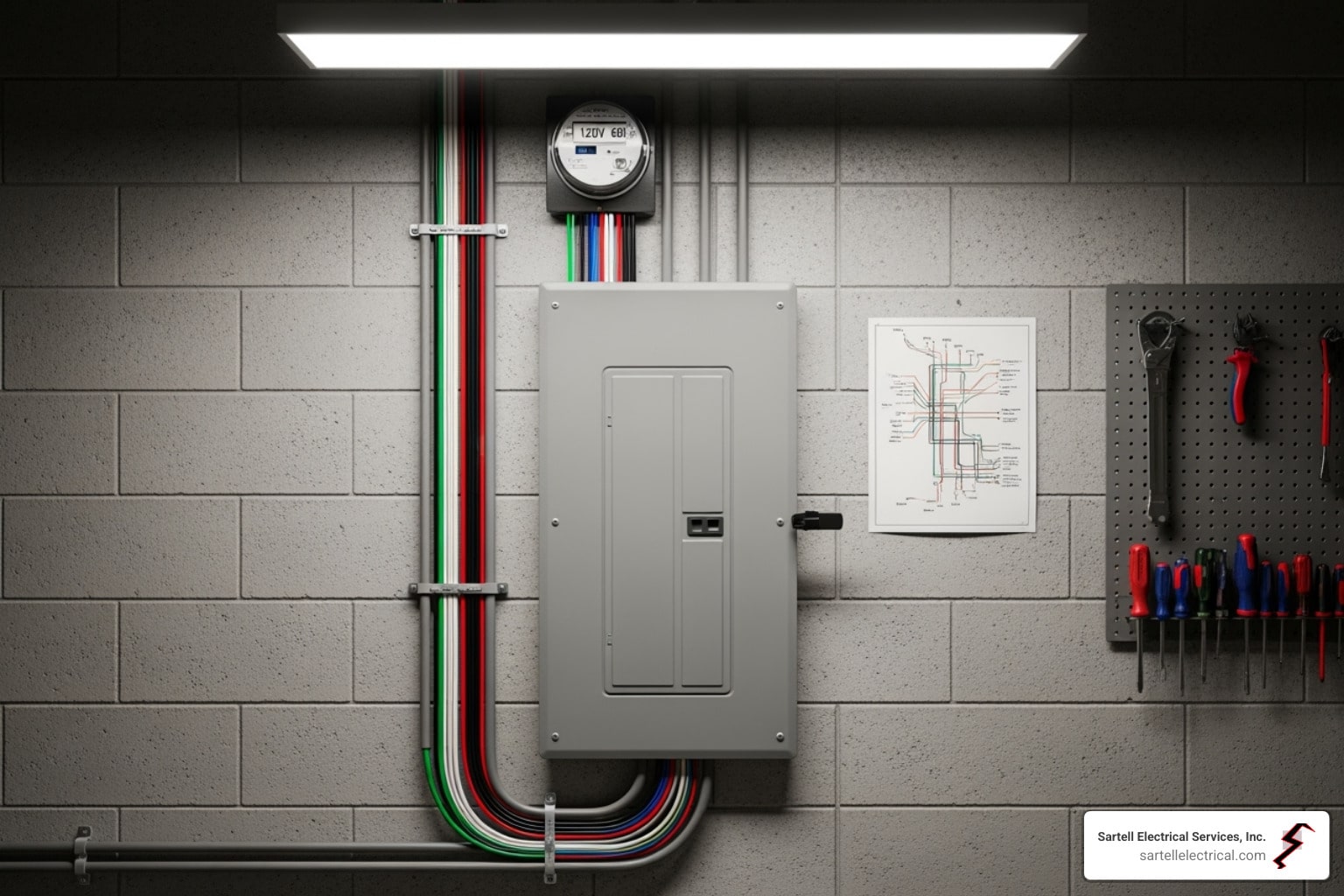
Home electrical panel upgrade cost typically ranges from $1,500 to $4,000 for most residential properties, with the final price depending on your current panel’s amperage, the upgrade size you need, and any additional electrical work required.
Quick Cost Breakdown:
Your home’s electrical panel serves as the central hub for all power distribution throughout your property. As modern facilities demand more electricity for advanced equipment, HVAC systems, and technology infrastructure, many older panels simply can’t keep up.
The consequences of an inadequate electrical system extend far beyond inconvenience. Overloaded panels pose serious fire risks, can damage expensive equipment, and may violate insurance requirements or building codes. For commercial and institutional properties, electrical failures can disrupt critical operations and create liability issues.
As Ed Sartell, President of Sartell Electrical Services with nearly four decades of experience since 1985, I’ve helped countless property owners steer home electrical panel upgrade cost decisions for both residential and commercial applications. My team understands that reliable electrical infrastructure is essential for maintaining operations and protecting your investment.
Electrical panels have a lifespan of 25 to 40 years. If your home was built before the 1980s, your panel is likely struggling to keep up. Today’s homes, with multiple computers, EV chargers, and smart systems, demand far more power than older panels were designed for.
After decades of electrical work across Massachusetts, I’ve seen these common warning signs countless times:
These warning signs are serious. An overloaded or outdated electrical panel poses real fire risks to your home and family.
The Electrical Safety Foundation International (ESFI) reports that electrical issues cause over 51,000 fires annually, leading to deaths, injuries, and billions in property damage. In my nearly four decades in this business, I’ve seen the devastating aftermath when these warning signs get ignored.
Beyond safety, an inadequate panel can cause appliance damage through inconsistent power, leading to costly repairs and replacements.
Insurance compliance is also a factor. Insurers may deny claims or raise premiums for unsafe, non-compliant electrical systems. Protecting your investment means ensuring your system is safe and reliable.
Don’t put off addressing these warning signs. They are your electrical system’s way of asking for help before a minor problem becomes a major disaster.
Let’s get straight to the numbers you’re looking for. When planning your home electrical panel upgrade cost, most homeowners in Massachusetts can expect to invest between $1,500 and $4,500 for a standard upgrade. In our experience serving communities from Boston to Springfield, including Middlesex, Essex, Norfolk, and Suffolk Counties, the sweet spot for most families typically lands around $3,000 for a comprehensive 200-amp upgrade.
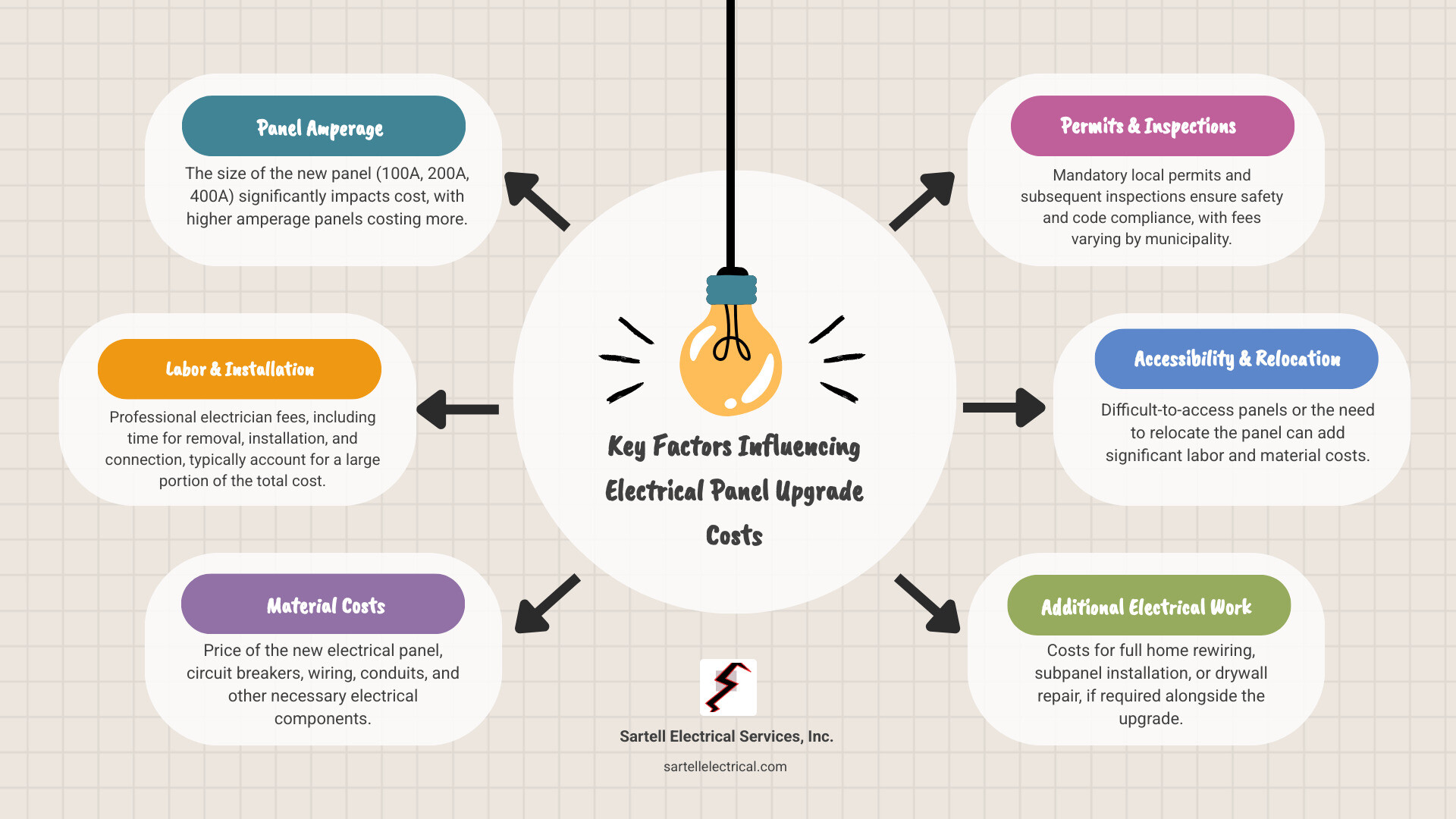
Think of your upgrade cost as having three main components. Labor costs represent the biggest chunk of your investment, and rightfully so. Professional electricians in our area charge between $55 and $85 per hour, with a typical panel upgrade taking our team about 8 to 10 hours to complete properly. This isn’t a corner you want to cut – electrical work demands expertise and precision.
Material costs vary significantly based on your chosen amperage. A basic 100-amp panel might cost around $100, while a robust 400-amp setup can exceed $500 just for the panel itself. Add in new circuit breakers, proper wiring, and essential hardware, and these costs add up quickly.
Don’t forget about permit fees – and please, never skip this step. Massachusetts municipalities typically charge between $50 and $300 for electrical permits. These fees cover the inspections that ensure your upgrade meets current safety codes. It’s money well spent for your family’s protection.
| Panel Amperage | Typical Cost Range (Panel + Installation) | Ideal Use Case |
|---|---|---|
| 100-Amp | $1,200 – $1,800 | Smaller homes (under 1,500 sq ft) with minimal electrical demands, few large appliances, no EV charging or central A/C. Often a direct replacement for an existing 100-amp panel. |
| 200-Amp | $1,800 – $4,500 | Standard for most modern homes (1,500-3,000 sq ft) with typical appliance loads, central air conditioning, and potential for future additions like EV chargers or electric water heaters. Most common upgrade. |
| 400-Amp | $8,000 – $12,000 | Very large luxury homes (over 3,000 sq ft), homes with extensive electrical demands like multiple HVAC systems, workshops with heavy machinery, commercial-grade appliances, or multiple EV charging stations. Often involves two 200-amp panels. |
A 100-amp panel represents the minimum standard for modern homes according to the National Electric Code. If you’re living in a cozy home without power-hungry amenities like central air conditioning or an electric vehicle charger, this might be all you need.
We typically see home electrical panel upgrade costs for 100-amp service ranging from $1,200 to $1,800. This price point makes sense for smaller properties under 1,500 square feet or homes with relatively modest electrical demands. It’s particularly cost-effective when we’re doing a straight replacement of an existing 100-amp panel that’s simply outdated or failing.
The beauty of a 100-amp upgrade lies in its simplicity. You get modern safety features and code compliance without paying for capacity you won’t use. However, think carefully about your future plans – adding that hot tub or EV charger later might push you beyond 100 amps.
Here’s where most of our Reading, MA clients end up, and it’s easy to see why. A 200-amp panel has become the gold standard for modern homes, offering that perfect balance of current needs and future flexibility.
This capacity comfortably handles multiple high-demand appliances like electric ranges, dryers, and water heaters without breaking a sweat. Add in central air conditioning systems, EV chargers, and all those smart home gadgets we love, and you’ll appreciate having the extra headroom.
The home electrical panel upgrade cost for 200-amp service typically runs between $1,800 and $4,500. The variation depends on several factors – whether we’re replacing an existing breaker panel or converting from an old fuse box makes a significant difference. Panel accessibility and any additional rewiring needs also influence the final price.
Most families find this upgrade provides excellent long-term value. You’re not just solving today’s electrical problems; you’re preparing for tomorrow’s innovations.
Now we’re talking serious electrical capacity. A 400-amp panel isn’t for everyone – it’s designed for homes with truly exceptional power demands or unique circumstances.
You might need this level of service if you own a large luxury home exceeding 3,000 square feet, operate workshops with heavy machinery, or have multiple HVAC systems serving different zones. Properties with multiple EV charging stations or commercial-grade appliances also fall into this category.
Expect to invest between $8,000 and $12,000 for a 400-amp upgrade. This substantial cost reflects the complexity of the installation, which often involves two 200-amp panels rather than a single 400-amp unit. The wiring requirements are more extensive, and the labor time increases accordingly.
While it’s a significant investment, homeowners who need this capacity usually recognize its value immediately. There’s nothing quite like the peace of mind that comes from knowing your electrical system can handle whatever you throw at it.
When homeowners ask us about home electrical panel upgrade cost, we always explain that the amperage is just the starting point. Think of it like renovating a kitchen – the cabinets might be your biggest expense, but it’s all those other details that can really add up.
Panel accessibility is one of the first things we assess during our initial visit. If your current panel is tucked away in a finished basement behind drywall or crammed into a tight utility closet, our team will need extra time to work safely and efficiently. Easy access means faster work, which translates to lower labor costs for you.
Sometimes, panel relocation becomes necessary – or simply desired. Maybe your current panel is in an inconvenient spot, or local code updates require it to be moved. Perhaps you’re finishing your basement and want the panel relocated to the garage. Moving an electrical panel is a significant undertaking that can add $800 to $4,000 to your project cost, since we’re essentially extending all your existing circuits to the new location.
Here’s something that catches many homeowners off guard: full home rewiring. When we open up an older panel, we sometimes find that the wiring throughout the house needs attention too. This is especially common in homes built before 1960. While not always necessary, rewiring can range from $6 to $10 per square foot, potentially adding $12,000 to $20,000 to the overall project. Don’t worry – we’ll always discuss this with you upfront if we spot any concerns during our assessment.
Subpanel installation might sound complicated, but it’s actually a smart solution for many situations. If you’re adding a detached garage, workshop, or large addition, installing a subpanel there is often more efficient than running individual circuits all the way back to your main panel. These typically cost between $400 and $1,800, depending on size and complexity.
Trenching for underground service comes up when homeowners want to move from overhead power lines to underground service, or when relocating a panel requires new underground wiring. It’s labor-intensive work that involves digging trenches for the new conduit, but many homeowners love the cleaner look it provides.
Let’s talk about drywall repair – it’s not glamorous, but it’s reality. Whenever we work behind walls or need to expand an opening for a larger panel, there’s potential for drywall damage. We’re careful, but sometimes it’s unavoidable. Budget around $1.50 to $3 per square foot for any needed repairs and touch-up painting.
Modern electrical codes in Massachusetts increasingly require specialty breakers like Arc Fault Circuit Interrupter (AFCI) and Ground Fault Circuit Interrupter (GFCI) breakers for improved safety. These advanced breakers cost more than standard ones – typically $35 to $100 each – but they provide crucial protection against electrical fires and shock hazards.
Finally, don’t overlook the meter box. If yours is old, damaged, or incompatible with your new panel size, it may need replacement. This can add $200 to $800 to the project cost.
Here’s some good news: you might be eligible for tax credits! The Energy Efficient Home Improvement Credit can cover up to 30% of your upgrade costs, with a limit of $600, when the panel upgrade is part of a larger energy efficiency project.
We believe in transparent pricing, which is why we always provide detailed, itemized quotes. No surprises, no hidden costs – just honest pricing for quality work.
If you’re living in a home with an old fuse box, you’re not just dealing with an inconvenience – you’re living with a genuine safety concern. We see these frequently in older Massachusetts homes, and the difference between upgrading a fuse box versus replacing an existing breaker panel is significant.
Fuse boxes are outdated technology that simply can’t handle modern electrical demands. Those little fuses with their thin metal strips that melt during overloads? They’re slow to react to dangerous electrical surges and need manual replacement every time they blow. Even worse, they rarely provide the 220-volt circuits needed for major appliances like electric dryers or ranges.
The safety hazards of fuse boxes extend beyond inconvenience. They pose a real fire risk and are a red flag for insurance companies. Many insurers will charge higher premiums for homes with fuse boxes, and some may even deny coverage altogether.
When we compare costs, replacing a fuse box with a circuit breaker panel typically ranges from $1,200 to $4,500 – generally on the higher end of the home electrical panel upgrade cost spectrum. Why more expensive? Because we’re essentially installing a completely new electrical distribution system, often including new grounding and sometimes partial home rewiring to bring everything up to current code.
Circuit breaker convenience is just one of many benefits. Instead of hunting for replacement fuses in the dark, you simply flip a switch to reset a tripped breaker. Modern breaker panels provide superior protection, can handle any electrical load your home demands, and give you peace of mind that your family and property are safe.
The investment is absolutely worth it. You’ll gain improved safety, increased home value, and the ability to fully accept modern electrical appliances and systems.
I’ll be straight with you: an electrical panel upgrade is absolutely NOT a DIY project. This isn’t like installing a ceiling fan or changing out a light fixture. We’re talking about working with live electrical service that can literally kill you.

In my nearly four decades in this business, I’ve seen the aftermath of DIY electrical disasters. The risks are real and terrifying. Electrocution is the most obvious danger – you’re working with enough power to stop your heart instantly. But even if you somehow avoid that, improper installation creates fire hazards that can destroy your home months or years later.
The National Fire Protection Association has documented countless cases where faulty electrical work led to devastating house fires. Loose connections, incorrect wire sizing, or improper grounding can cause dangerous arcing and overheating that you might not notice until it’s too late.
Then there’s the code compliance issue. Massachusetts has specific amendments to the National Electrical Code, and they’re not suggestions – they’re the law. Code violations can result in hefty fines, failed inspections, and major headaches when you try to sell your home. Even worse, most insurance companies will deny claims for damage caused by unpermitted electrical work.
Here’s how we handle your home electrical panel upgrade cost investment the right way:
Assessment and Planning: We start by thoroughly evaluating your current system and discussing your electrical needs. This isn’t a cookie-cutter approach – every home is different.
Permitting Made Simple: We handle all the paperwork with your local Massachusetts municipality. No standing in line at city hall or trying to decipher permit applications.
Utility Coordination: We work directly with your power company to schedule the temporary service disconnect. This ensures we can work safely while minimizing your time without power.
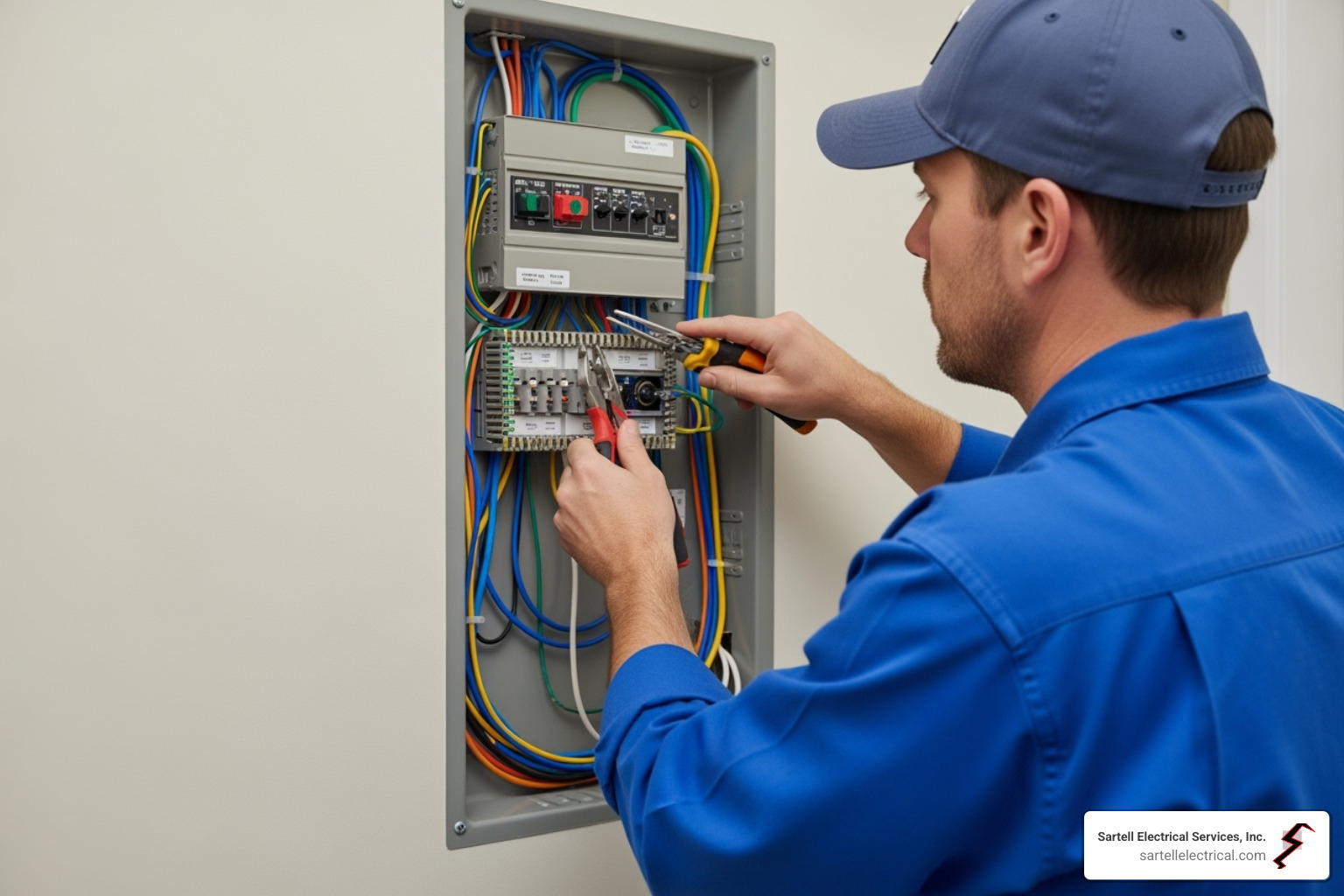
Professional Installation: Our licensed team carefully installs your new panel, making sure every connection is secure and properly grounded. A typical project takes 8 to 10 hours, and we usually complete it in a single day to get your power back on quickly.
Inspection and Sign-off: We schedule all required inspections and make sure everything passes before we consider the job complete. Only after the inspector gives the green light do we restore full power to your home.
With over 30 years of experience serving Massachusetts families, we’ve streamlined this process to be as painless as possible for you. When you hire Sartell Electrical Services, you’re not just paying for the upgrade – you’re investing in the peace of mind that comes with knowing the job was done right the first time.
After nearly four decades in the electrical business, I’ve heard just about every question you can imagine about panel upgrades. Whether you’re sitting at your kitchen table wondering if those flickering lights are a problem, or you’re deep into planning a home renovation, these are the questions that keep homeowners up at night. Let me put your mind at ease with some straight answers.
Absolutely, yes! This is one of my favorite questions because the answer is so encouraging. Upgrading your electrical panel is like giving your home a clean bill of health – and potential buyers notice that immediately.
When someone’s house-hunting, they’re looking at everything from the roof to the foundation. A modern electrical panel tells them the home is safe, up-to-date, and ready for their lifestyle. No one wants to inherit electrical problems, and frankly, most buyers today expect to plug in their electric vehicles, run multiple air conditioning units, and power all their smart home gadgets without worry.
We’ve seen homes sell faster and for better prices after an electrical upgrade. It’s not just about the monetary value – though that’s certainly there – it’s about peace of mind and marketability. Your home becomes more attractive to a wider range of buyers when they know the electrical system can handle whatever they throw at it.
Here’s some good news: a standard electrical panel upgrade typically takes our team between 8 to 10 hours, and we usually complete the work within a single day. I know losing power for even a few hours can feel overwhelming, especially if you work from home or have medical equipment that needs electricity.
We plan everything carefully to minimize power disruption. Our team arrives early, works efficiently, and coordinates with your utility company to restore service as quickly as possible. Of course, if we find additional issues – like old wiring that needs attention – the timeline might extend. But we’ll always discuss that with you before proceeding.
The beauty of modern electrical work is that once we flip that main breaker back on, you’ll have decades of reliable service ahead of you. One day of inconvenience for 25-40 years of worry-free power? That’s a pretty good trade-off.
Yes, and I’m always happy to help homeowners take advantage of this! You may be eligible for the Energy Efficient Home Improvement Credit, which can cover up to 30% of your home electrical panel upgrade cost, with a limit of $600.
Here’s the catch – and it’s not a bad one – the upgrade needs to be part of a larger energy efficiency project. Maybe you’re also installing a heat pump, upgrading your insulation, or adding solar panels. When your electrical panel upgrade supports these energy-efficient improvements, Uncle Sam wants to help with the cost.
We provide all the documentation you need to claim this credit. Keep your receipts, and don’t forget to mention this to your tax preparer. Every little bit helps when you’re investing in your home’s safety and efficiency.
The process is straightforward, and the savings are real. I’ve had clients who were pleasantly surprised by their tax refunds after completing electrical upgrades as part of home efficiency projects. It’s like getting a thank-you note from the government for making smart home improvements.
When you understand the home electrical panel upgrade cost, you’re already ahead of the game. But understanding the investment is just the beginning—taking action to secure your home’s power and safety is what really matters.
Think of an electrical panel upgrade as more than just a home improvement project. It’s your family’s safety net, protecting everyone you love from electrical fires and hazards. It’s your appliance insurance, ensuring your expensive electronics and equipment get the clean, consistent power they need to last. And it’s your peace of mind, knowing your home can handle whatever electrical demands life throws at it.
The benefits go far beyond just keeping the lights on. With improved safety features, increased electrical capacity, and future-proofing against our ever-growing electrical needs, a panel upgrade is one of those rare home improvements that pays dividends every single day. You’ll never have to worry about tripped breakers during family movie night or wonder if it’s safe to plug in that new appliance.
Don’t let an outdated or overloaded electrical system become a ticking time bomb in your home. The warning signs we’ve discussed—flickering lights, frequent breaker trips, that concerning buzzing sound—they’re not going to fix themselves. In fact, they typically get worse over time.
Here’s where experience makes all the difference. At Sartell Electrical Services, we’ve been helping Massachusetts families upgrade their electrical systems for over 30 years. We’ve seen how a properly installed electrical panel transforms a home from a potential safety hazard into a secure, efficient living space.
Our team handles everything from start to finish—the initial assessment, permit applications, utility coordination, professional installation, and final inspections. We work across Reading, MA, Greater Boston, and throughout Essex, Middlesex, Norfolk, and Suffolk Counties, bringing the same commitment to excellence whether it’s a simple 100-amp upgrade or a complex 400-amp installation.
Your home deserves an electrical system that works as hard as you do. One that keeps your family safe, powers your modern lifestyle, and gives you confidence for years to come.
Ready to take the next step? Explore our Residential Electrical Services to learn more about how we can help secure your home’s power and safety. Let’s make sure your electrical project is done right the first time.

236 Ash St Reading, MA 01867
(By Appointment Only)
