
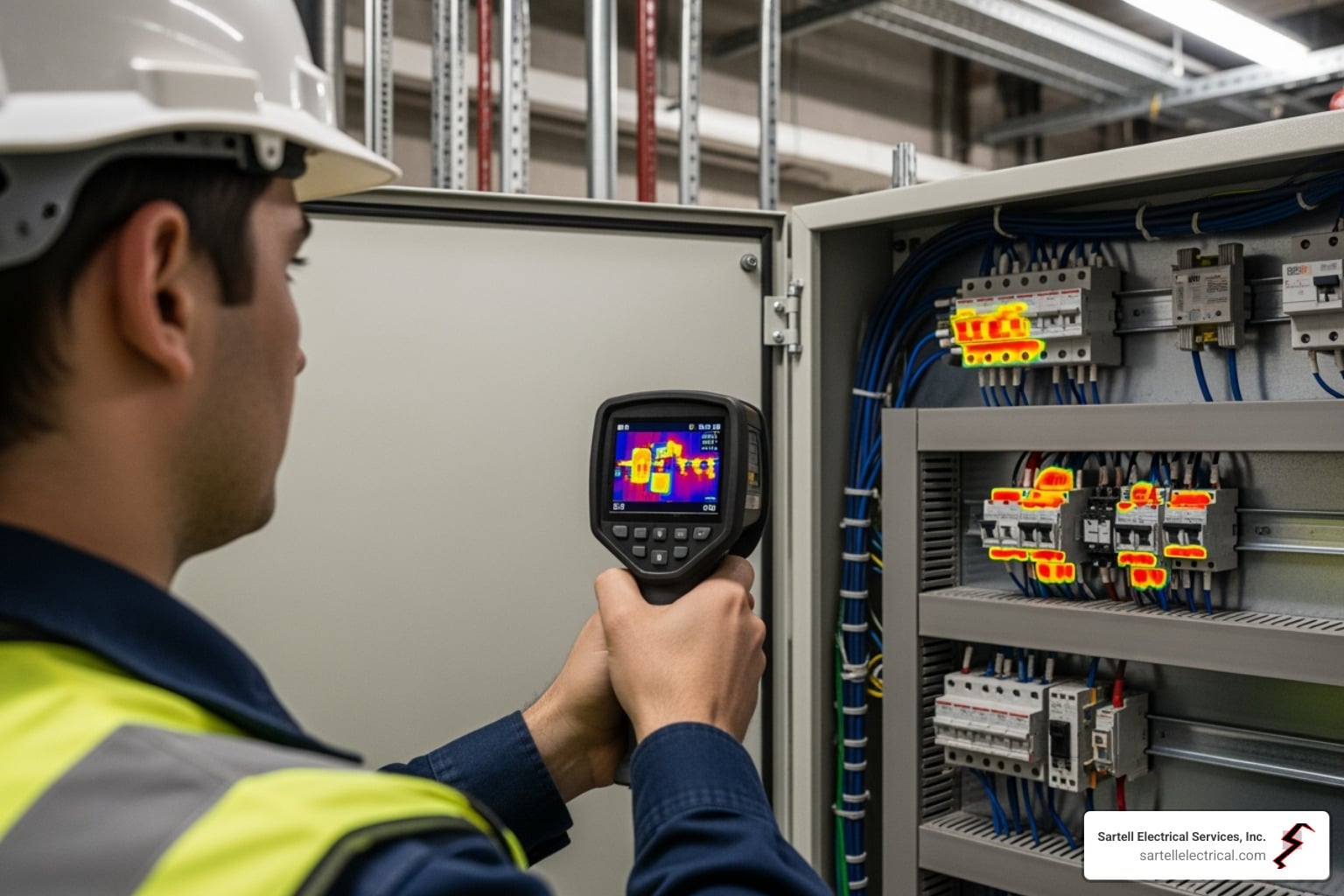
Electrical condition monitoring uses various techniques to measure physical parameters of electrical equipment, identifying changes that signal developing faults before they cause costly failures.
Primary Monitoring Techniques:
Key Benefits:
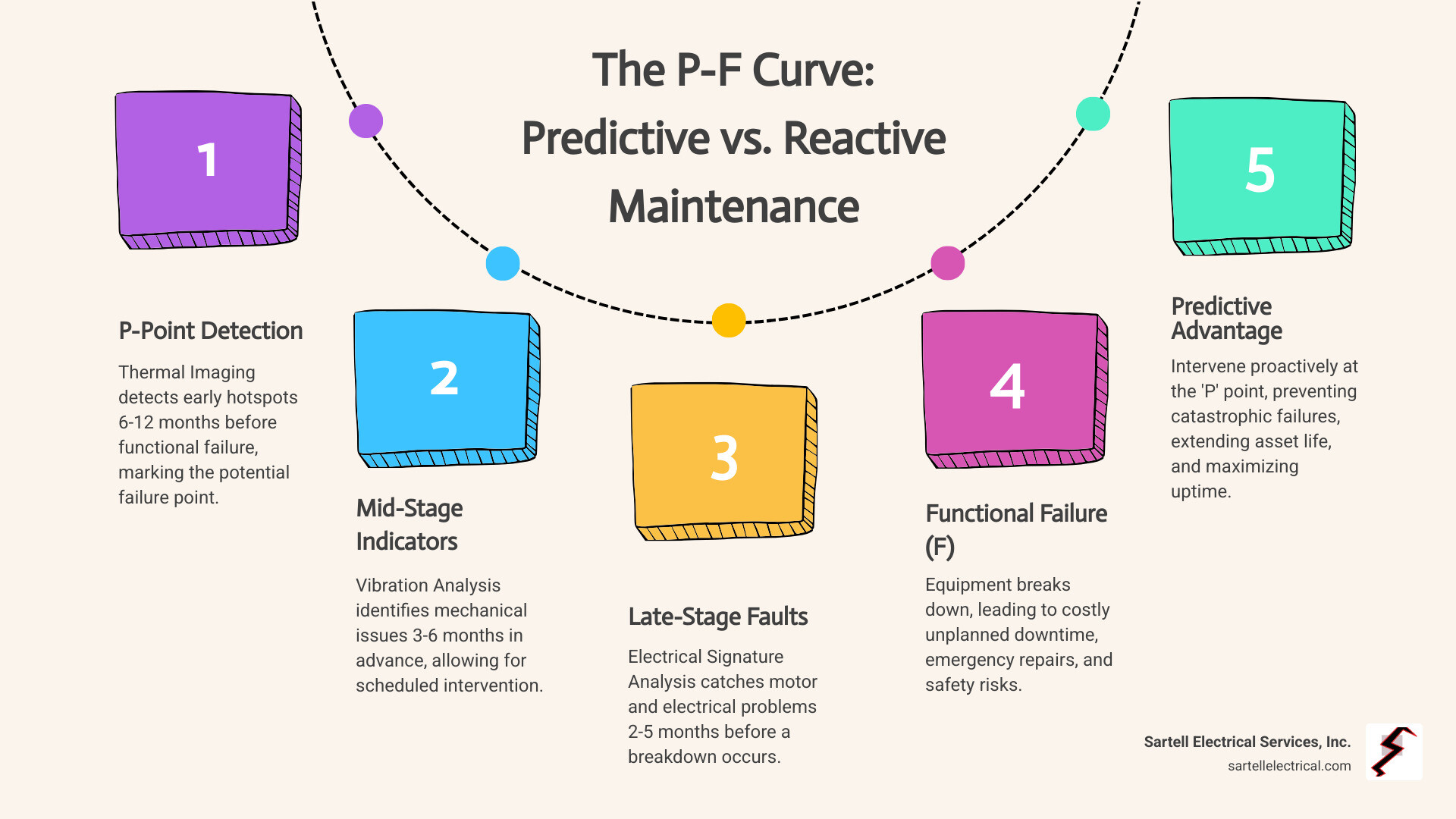
The stakes are high. Equipment breakdowns account for about 30% of downtime in manufacturing plants, costing millions annually. Even brief power interruptions can cripple operations. Traditional reactive maintenance is no longer sustainable. Smart businesses are shifting to predictive maintenance strategies using electrical condition monitoring to catch problems months before they become failures.
This technology can “see” developing problems invisible to the naked eye, like a loose connection generating heat that thermal imaging can detect long before it causes a fire.
As Ed Sartell, President of Sartell Electrical Services with nearly four decades of experience, I’ve seen how electrical condition monitoring transforms maintenance from costly emergencies into planned, budget-friendly interventions. Our team has helped countless Massachusetts businesses implement monitoring strategies that keep their critical systems running smoothly while reducing costs and safety risks.
Proactive electrical condition monitoring is a game-changer for modern businesses, delivering benefits that range from ensuring consistent uptime to safeguarding your most valuable assets: your people.
Effective electrical condition monitoring allows businesses to move away from the costly “fix-it-when-it-breaks” mentality. Equipment breakdowns account for about 30% of downtime in manufacturing plants, and the true cost of unplanned downtime is often underestimated, including lost production, emergency repair costs, and reputational damage.
By investing in electrical condition monitoring, we can:
Condition monitoring increases reliability, availability, and uptime for machines and equipment by reducing downtime. It ensures that your critical electrical infrastructure is always performing at its peak, safeguarding your bottom line.
For more detailed information on how we help businesses with their electrical infrastructure, visit our page on Industrial Electrical Services.
Unplanned electrical failures pose a major threat to employee safety. Electrical condition monitoring is vital for creating a safer working environment.
By predicting when a machine will break, condition monitoring not only enables teams to schedule repairs well before functional failure, but it also provides the means to prevent crippling maintenance costs and, most importantly, protect lives.
Learn more about how condition monitoring sensors can contribute to a safer workplace on this page: Using condition monitoring sensors to reduce risk.
We use cutting-edge techniques to spot potential issues long before they become costly emergencies. The toolbox for electrical condition monitoring includes both online methods (gathering data while equipment runs) and offline methods (testing while equipment is off). The goal is always to collect and analyze data to understand the health of your vital assets.
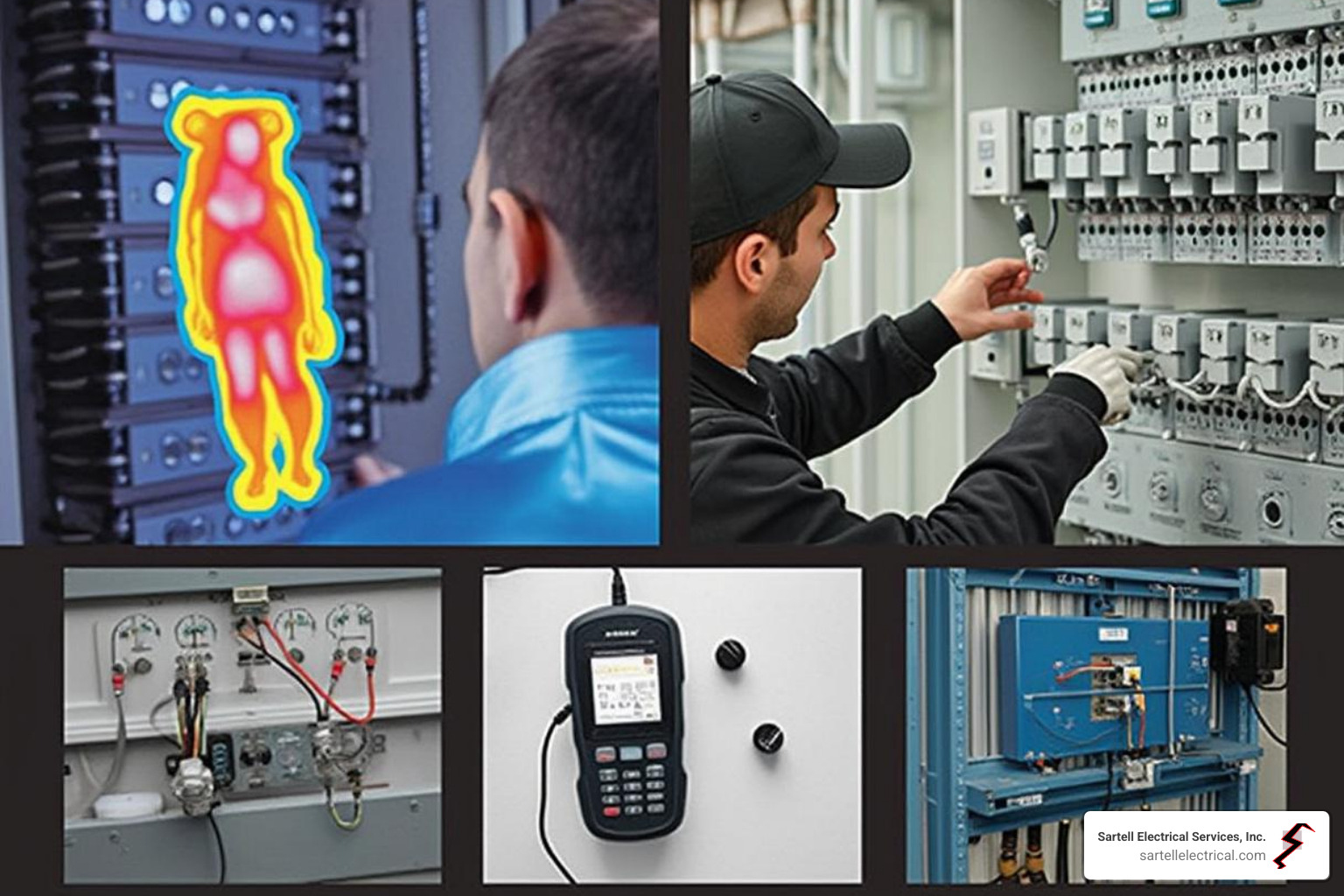
Thermal imaging, or infrared thermography, is a non-invasive technique that allows us to “see” heat. It’s powerful for finding problems like loose connections, corroded terminals, and overloaded circuits, which all generate heat before they fail. A thermal camera makes these “hot spots” visible, allowing us to pinpoint areas of high temperature and prevent failures or fires. We can also identify circuits drawing too much current or failing cooling systems on equipment like transformers. It’s a simple, effective way to catch small issues before they become major problems.
Vibration analysis is crucial for rotating electrical equipment like motors and generators. Every machine has a unique “vibration signature.” Changes to this signature indicate developing problems. We can spot misalignment between a motor and the equipment it drives, which causes excessive vibration and wear. We can also detect bearing wear long before a catastrophic failure, or identify an unbalanced rotor that wastes energy and causes damage. By analyzing these vibrations, we can diagnose mechanical stress and keep your operations running smoothly.
Electrical Signature Analysis (ESA) and Motor Circuit Analysis (MCA) are powerful techniques that analyze electrical signals to assess equipment health.
Electrical Signature Analysis (ESA) is an online method that examines the current and voltage of a running motor or generator. It can detect both electrical and mechanical problems, including rotor bar faults, winding insulation issues, and power quality problems. Advanced ESA can even function as a “sensorless” method for monitoring hard-to-reach equipment. Research shows ESA can detect over 90% of failures up to 5 months in advance. You can read more about this approach here: A sensorless condition monitoring method.
Motor Circuit Analysis (MCA) is an offline test performed when the motor is off. It checks the motor’s internal components by measuring resistance and insulation quality, making it excellent for finding winding faults or insulation degradation.
Here’s a quick look at how these powerful techniques compare:
| Technique | Fault Types Detected | Equipment Type Primarily Monitored | Implementation Cost (Relative) |
|---|---|---|---|
| Thermal Imaging | Hotspots, loose connections, overloaded circuits, cooling issues, insulation breakdown | Electrical panels, switchgear, transformers, motors, connections | Low to Medium |
| Vibration Analysis | Misalignment, bearing wear, imbalance, looseness, cavitation, gear defects | Rotating machinery (motors, pumps, fans, generators) | Medium to High |
| Electrical Signature Analysis (ESA) | Rotor bar cracks, winding faults, bearing issues, mechanical imbalances, power quality problems | Electric motors, generators, driven equipment | Medium to High |
The Industrial Internet of Things (IIoT) and digitalization have transformed electrical condition monitoring. Modern systems collect real-time data continuously, providing an up-to-the-minute picture of equipment health. This data is sent to cloud-based platforms for storage and analysis. Here, AI and machine learning for fault prediction can identify subtle patterns in the data that indicate developing faults. This technology enables remote monitoring capabilities, which is ideal for distant or hard-to-reach assets. It also provides scalable insights, allowing you to monitor a single machine or an entire plant. This blend of AI and IIoT makes modern monitoring systems more effective, efficient, and user-friendly than ever.
Collecting data is one thing; using it to your advantage is where the real power of electrical condition monitoring lies. We help you turn data into a roadmap for smarter operations, weaving insights into your maintenance routines for proactive control.
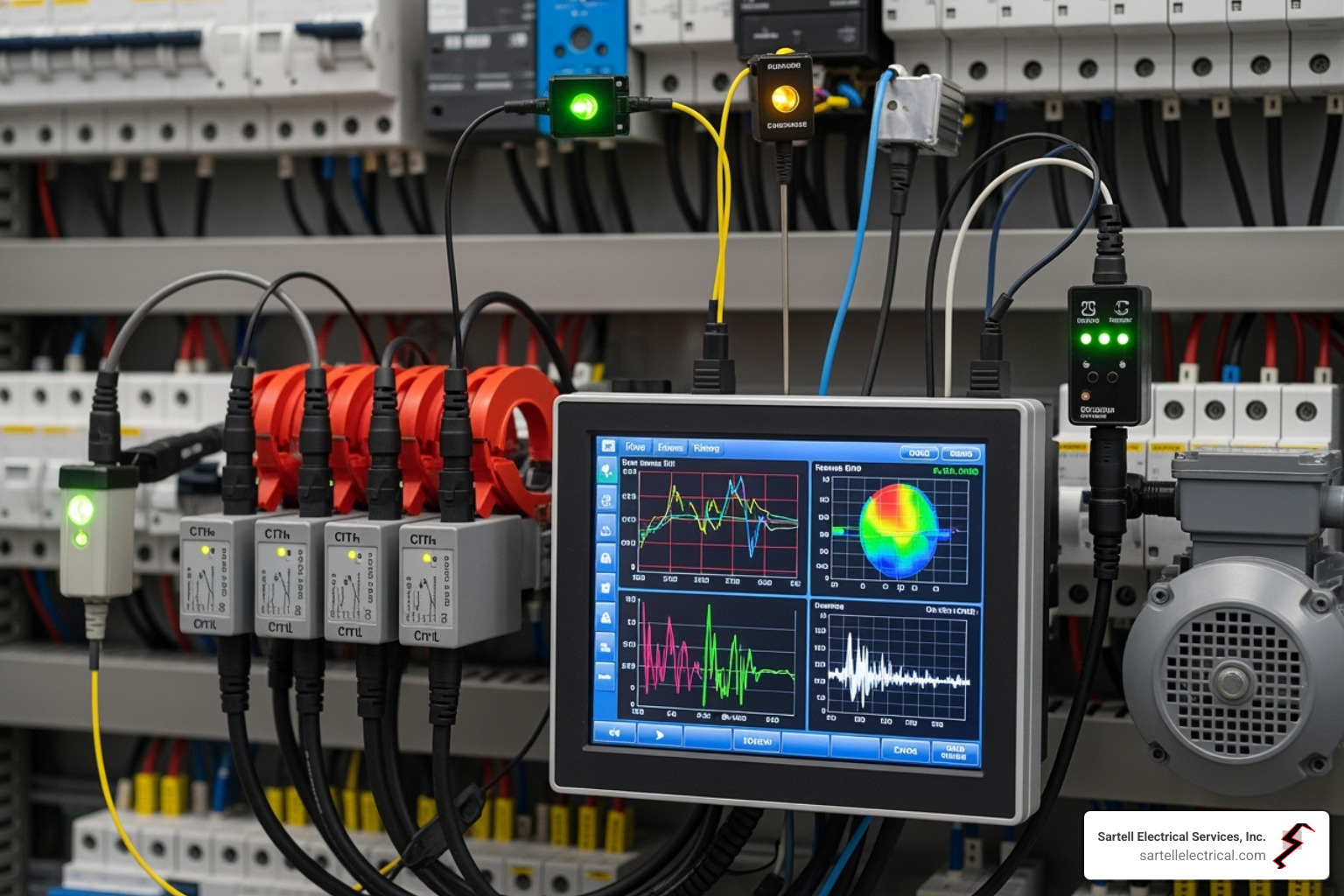
A robust monitoring strategy combines sensors (the eyes and ears), data acquisition systems (the note-takers), and software (the brain). The software analyzes data, displays it on dashboards showing equipment health metrics, and sends critical alerts. Nearly any business that relies on electrical equipment can benefit, including manufacturing plants, healthcare facilities, data centers, and other critical industries like food and water production, fuels, paper, and medicines. The need for reliable electrical systems is universal.
The ultimate goal of electrical condition monitoring is predictive maintenance. This means moving beyond rigid, time-based schedules and reacting to failures after they happen. Instead, we use real-time data to predict when a component needs attention and schedule maintenance just in time. This is achieved by:
For environments where reliability is non-negotiable, like healthcare facilities, predictive maintenance is invaluable. Consistent power is paramount in these settings. To learn more about how we support these vital operations, check out our page on Health Care Electrical Services.
Choosing the right electrical condition monitoring solution requires a custom approach, as there is no one-size-fits-all answer. At Sartell Electrical Services, we guide you through the process to find the perfect fit for your business. Our approach involves:
Our team will work with you to design and implement a custom electrical condition monitoring solution that delivers maximum value and peace of mind.
Over the years, we’ve had countless conversations with business owners who are curious about electrical condition monitoring. These are some of the most common questions we receive.
While almost any electrical equipment can benefit, monitoring provides the highest return on investment for assets that are critical, expensive, or dangerous when they fail. Key examples include:
For businesses looking to protect their electrical infrastructure, our Commercial Electrical Services page has more information.
The ideal frequency depends on several factors, as there is no one-size-fits-all answer.
The goal is to find the sweet spot that catches problems early without excessive cost. We work with you to create a monitoring schedule that fits your needs and budget.
While implementing electrical condition monitoring has challenges, they are all manageable with the right approach.
Despite these problems, the long-term gains in reliability, cost savings, and safety make the effort worthwhile.
From thermal imaging to electrical signature analysis, it’s clear that electrical condition monitoring is a game-changer. It’s about making your systems run efficiently, safely, and predictably. By spotting trouble months in advance, you can move from stressful emergency repairs to planned, smart interventions. This leads to significant cost savings, improved uptime, a longer equipment lifespan, and a safer workplace.
The future of maintenance is smart and data-driven, powered by IoT and AI. This allows for precise, need-based care instead of guesswork. However, open uping the full power of electrical condition monitoring requires expertise in setup, data analysis, and action planning. That’s where we come in.
For businesses in Massachusetts, Sartell Electrical Services is your trusted partner for expert guidance and seamless implementation of robust monitoring strategies. We ensure your electrical infrastructure is not just reliable, but resilient. Don’t let unexpected electrical failures disrupt your operations. We’re here to help you master electrical condition monitoring for a brighter, more reliable future. Ready to chat? Contact us to discuss your industrial electrical needs today!

236 Ash St Reading, MA 01867
(By Appointment Only)
